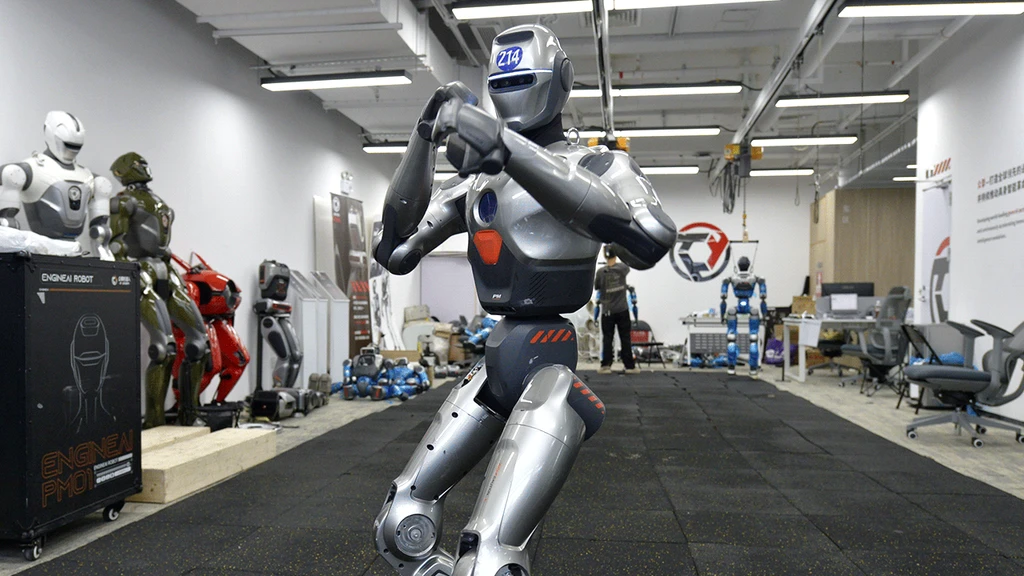
Humanoid robots are moving beyond raw speed and acrobatics to demonstrate crucial control when faced with unexpected events. The new EngineAI PM01 humanoid robot has been shown maintaining its balance after being deliberately pushed, performing a controlled slip, and smoothly regaining its rhythm. It also executes front flips as part of a demonstration of advanced balance and recovery.
EngineAI pushes back on CGI skepticism as its PM01 humanoid robot demonstrates controlled recovery and dynamic motion. (Liu Lihang/Xinhua via Getty Images)
Speed may grab attention, but recovery earns trust. When pushed, the PM01 recalculates its center of mass and adjusts its posture in real-time. This sophisticated control relies on tight coordination between sensors, actuators, and AI algorithms. Executing a front flip, a more challenging maneuver than a backflip, requires coordinated arm swing, core stabilization, and precise landing mechanics.
The PM01's compact size, under 4 feet tall, offers advantages. A lower center of mass reduces tipping risk and requires less rotational force for flips. Its lighter structure also helps distribute impact forces more effectively upon landing. This agility is beneficial in research and development settings.
The PM01 robot stands on display at EngineAI's robot retail flagship store in Shenzhen, Guangdong Province of China. Newly released footage shows the PM01 humanoid absorbing a push and recalculating its center of mass within seconds. (VCG/VCG via Getty Images)
Under the hood, the PM01 integrates an Intel RealSense depth camera for visual awareness and spatial mapping, coupled with a dual-chip setup featuring NVIDIA Jetson Orin and an Intel N97 processor. This architecture supports real-time AI workloads and rapid balance correction. With 24 degrees of freedom and 12 joint motors, it allows for smooth, coordinated movement.
EngineAI has also addressed CGI skepticism by releasing footage of its robots physically interacting with its CEO, emphasizing real-world operation. This credibility push is vital in a competitive robotics market.
The nearly 4-foot-tall EngineAI PM01 uses AI-powered sensors and joint motors to recover from slips and continue moving. (VCG/VCG via Getty Images)
For real-world applications in warehouses, hospitals, or homes, a humanoid robot's ability to handle bumps and slips without causing damage is critical. A machine that can brace itself, fall safely, and stand back up is far more practical than one performing a single choreographed stunt. As humanoids move closer to everyday environments, resilience is as important as athletic performance.
Ultimately, the breakthrough in humanoid robotics lies not in the flip, but in the recovery. The EngineAI PM01 demonstrates how compact design and real-time correction can help a machine stay upright and continue moving without chaos. This shift from viral demo moments to robots built for everyday reliability is paving the way for wider adoption.