
Economists once assured the public that advanced technology would augment, not replace, human jobs. That consensus is now under significant strain.
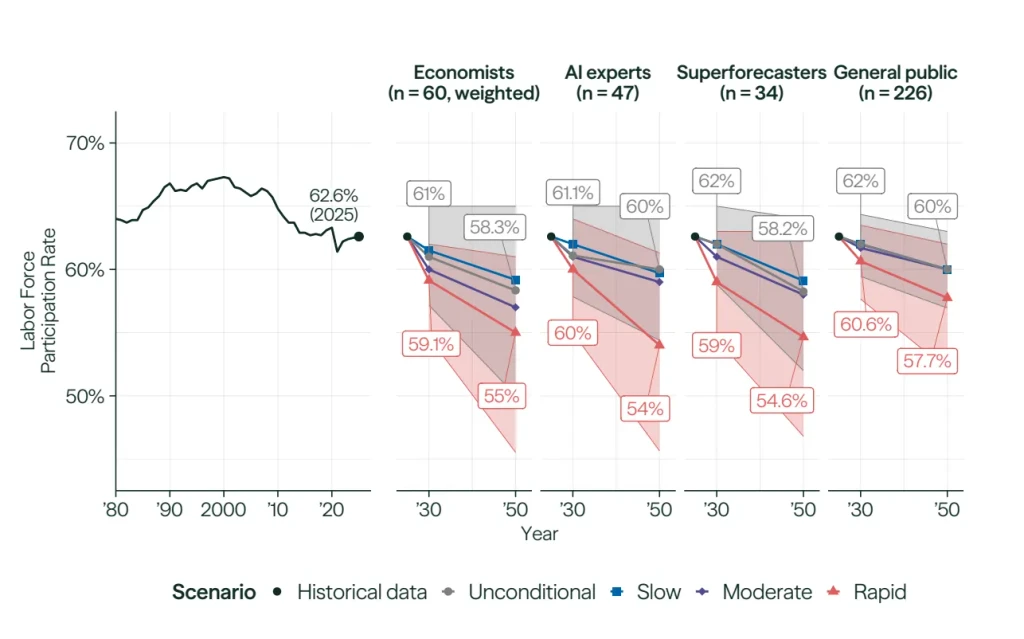
A major study involving researchers from the Federal Reserve Bank of Chicago, Yale, Stanford, and the University of Pennsylvania surveyed economists, AI specialists, and superforecasters. All groups concur: faster AI progress correlates with lower labor force participation.
Under a "rapid" AI development scenario, where AI surpasses human performance in most tasks by 2030, economists forecast the U.S. labor force participation rate dropping from 62% to 54% by 2050. This projects approximately 10 million jobs lost directly to AI.
While GDP growth is projected to be robust, potentially hitting 3.5% annually by 2045-2049, wealth creation is expected to be highly concentrated. The wealthiest 10% of households could hold 80% of total wealth by 2050.
The core debate has shifted from AI's arrival to its ultimate economic impact, specifically whether AI can automate the creation of new job categories-a departure from previous technological disruptions.
While aggregate employment data remains stable, research indicates a notable 13% relative employment drop among younger workers in AI-exposed occupations. Economists favor retraining programs, largely rejecting job guarantees or universal basic income.