
Ethereum co-founder Vitalik Buterin has detailed a four-year roadmap aimed at dramatically accelerating block production and transaction confirmations on the Ethereum network. The plan, visualized on a public "Strawmap" by the Ethereum Foundation's Protocol team, seeks to reduce the current 12-second slot time down to as little as 2 seconds.
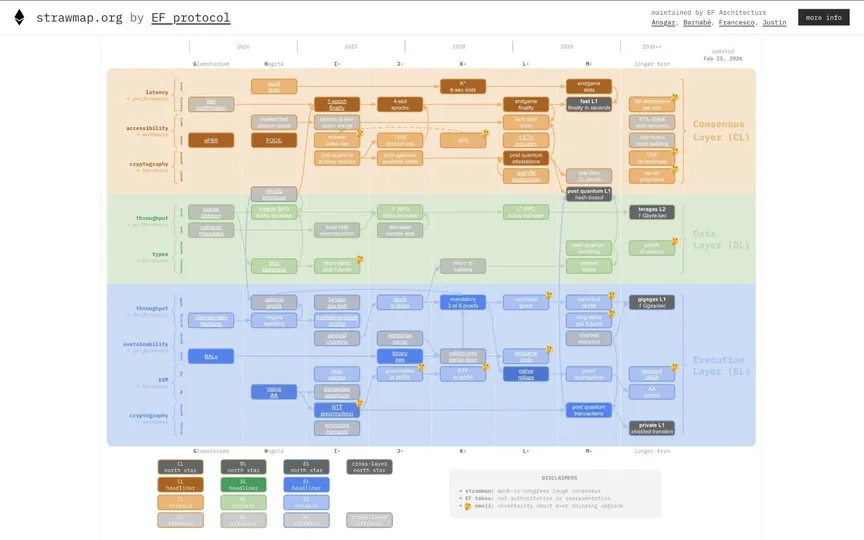
This acceleration will make the blockchain feel more responsive. Buterin expects incremental reductions, progressing from 12 seconds down through 8, 6, 4, and eventually 2 seconds. P2P network improvements will also play a key role in reducing block propagation time, enabling shorter slots without compromising security.
A second major focus is reducing transaction finality, the point at which a transaction is irreversibly confirmed. The current 16-minute finality is targeted to decrease to between 6 and 16 seconds. This will be achieved by replacing the existing complex confirmation system with a simpler, quantum-resistant architecture. Buterin highlighted that this approach will lead to quantum-resistant slots before finality is fully secured, ensuring chain continuity even in the event of sudden quantum computing threats.
These extensive changes will be implemented through a "component-by-component replacement" of Ethereum's slot structure and consensus. The overhaul aims to create a cleaner, simpler, quantum-resistant, and formally verified alternative. The roadmap spans four years, featuring approximately seven hard forks scheduled every six months, with "Glamsterdam" and "Hegotá" confirmed for later this year.