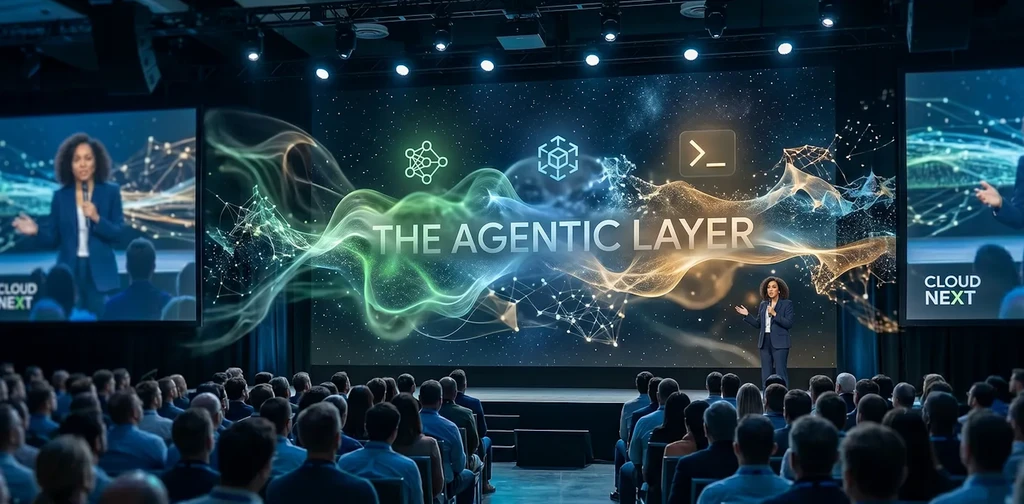
Google Cloud Next is poised to unveil a significant strategic shift, moving beyond the expected AI announcements to focus on establishing the 'operating system' for the agentic enterprise. This move aims to capture the future of enterprise execution by owning the control plane, a layer most of the industry has yet to fully acknowledge.
The distinction is crucial: features are secondary to platforms, and operating systems define the platform. Google's ambition is to transition from selling tools to owning the runtime where actual work is performed. This aligns with the enterprise stack's evolution from systems of record and engagement to systems of execution.
The industry conversation remains fixated on model superiority and benchmark scores, a debate already becoming obsolete. The critical question, largely unasked, is who controls the plane where AI executes tasks. As models and inference costs commoditize, leverage shifts to orchestration, governance, identity, and execution-the layer Google is targeting.
Key areas to watch at Google Cloud Next include:
- Agent Infrastructure: Redesigning for persistent, always-on agents, requiring specialized silicon, AI-optimized networking, and storage for continuous execution.
- Data as AI Memory: Evolving data platforms into context engines for agents, emphasizing AI reasoning over data location. Google aims to make BigQuery and its data fabric the primary reasoning surface.
- Gemini as a Control Plane: Repositioning Gemini as an orchestration layer, agent runtime, governance system, and integration point, directly competing with similar offerings from AWS, Microsoft, and Salesforce.
- Autonomous Security: Moving security operations from dashboards to autonomous systems for continuous threat detection and remediation, leveraging Google Cloud's Mandiant asset.
- The Dying App Layer: Google Workspace is being repositioned as an agent interaction surface, a coordination layer for work, signifying a shift where agents, not applications, become the primary product.
Google's strategy is to integrate these layers into a single system, a bold move against formidable competitors like AWS, Microsoft, Databricks, Snowflake, and Salesforce. The success hinges on Google's enterprise go-to-market execution and the adoption of its agent platform by developers.
The real significance of this event lies not in AI feature drops, but in Google's bet on a control plane for autonomous, multi-agent work. This could reset the enterprise stack, with competitors poised to capitalize if Google falters.