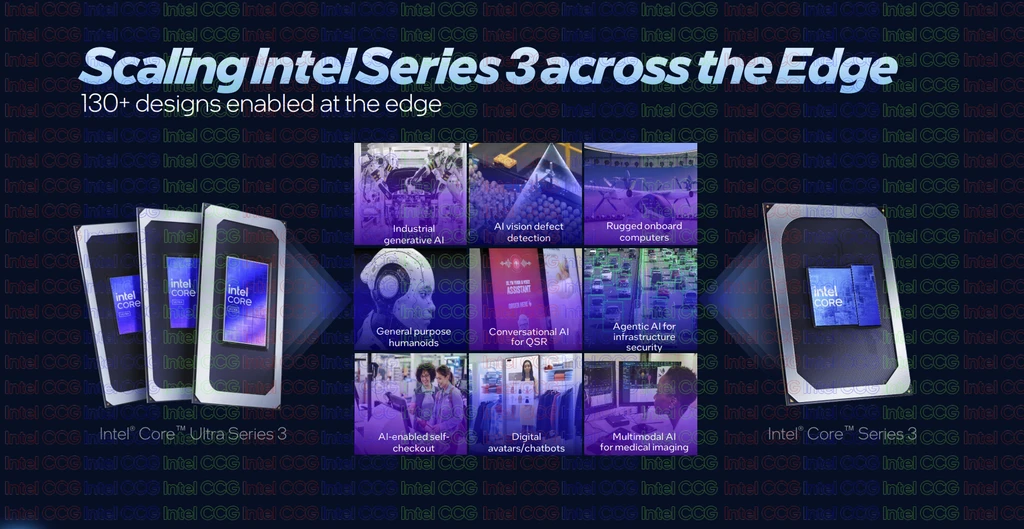
Intel Corp. today announced more than 130 design engagements for its Series 3 processor family, designed for edge AI and computing. The company also unveiled OpenVINO Physical AI, an open-source framework aimed at bridging the gap between lab-based robotics models and production fleets on factory floors.
The announcements, made ahead of Computex in Taipei, position Intel's edge silicon and software stack as a unified alternative to the fragmented mix of CPUs and discrete accelerators dominating robot design. The Series 3 family, launched at CES in January, is the debut product on Intel's 18A manufacturing process.
Anchoring the design momentum is SensoryAI Inc., which migrated its multi-agent retail robot Ella to Intel architecture. Ella now runs three specialized AI agents-Avatar, Guardian, and Ella-on a single Intel Core Ultra Series 3 platform, eliminating a separate accelerator and reducing software complexity.
Other design wins include industrial generative AI, AI vision defect detection, conversational AI for quick-service restaurants, and multimodal AI for medical imaging.
OpenVINO Physical AI extends Intel's existing toolkit, providing developers with a consistent way to deploy robot policies and multimodal models while maximizing inference performance. It integrates with Intel's Physical AI Studio and the open-source LeRobot project.
Intel argues the framework solves a key industry problem: deploying physical AI at scale has required customized pipelines and dual-compute solutions. Pairing Series 3 with OpenVINO Physical AI allows lower total cost of ownership and easier fleet scaling.
"Physical AI models are transforming robotics, but deployment has been slowed by fragmented software stacks and one-off integrations," said Dan Rodriguez, corporate vice president of Intel's Edge Computing Group. "We provide a unified, open and scalable path from AI experimentation to production-grade robots."
Intel also pitched Series 3 on cost, claiming competitive performance against Nvidia's Jetson AGX Orin and Jetson Thor T5000 at roughly half the system cost.
Physical AI Studio is available now. OpenVINO Physical AI is available in preview on GitHub, with general availability targeted for the second half of 2026.