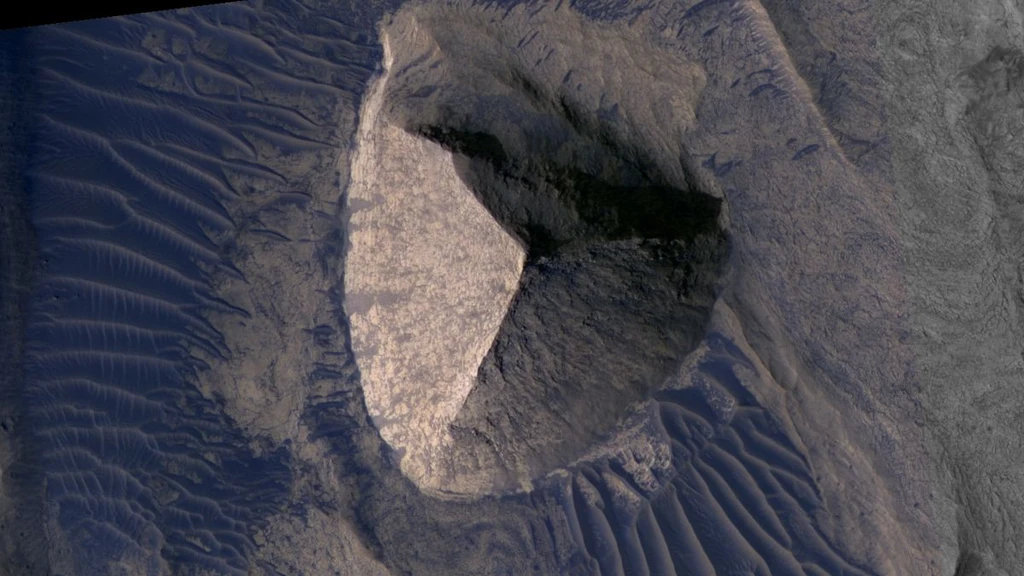
A mysterious structure on Mars resembling a three-sided pyramid has resurfaced online, sparking speculation about artificial origins. The formation, located in the wind-sculpted valley of Candor Chasma, was first spotted in 2002 in imagery from NASA’s Mars Global Surveyor.
Despite its geometric appearance in cropped images, high-resolution data from NASA’s Mars Reconnaissance Orbiter shows the so-called “Candor Tetrahedron” is consistent with natural geological processes. It measures approximately 290 meters wide and 145 meters tall-larger than typical erosion-resistant “knobs” in the region but still within expected parameters.
Geologists explain that such features form when harder rock layers resist erosion while surrounding softer material wears away over billions of years due to wind, ancient water flows, landslides, and possibly tectonic shifts. The ridges on the formation are uneven and asymmetrical-unlike engineered structures-and sit amid aeolian ripples shaped by Martian winds.
Similar natural pyramids exist on Earth, including Cerro Tusa in Colombia and formations in China’s Guizhou province. Scientists attribute public fascination to pareidolia-the human tendency to see patterns in randomness-especially familiar shapes like pyramids or faces.
NASA confirms the images are authentic but stresses there’s no evidence of artificial construction. Mars remains scientifically compelling without alien embellishment.