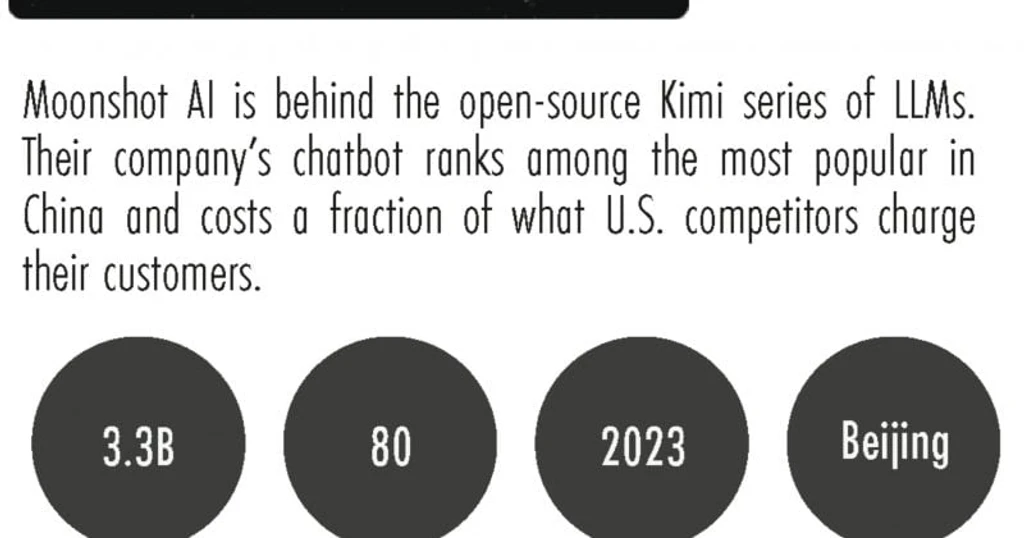
Moonshot AI, the Beijing-based developer behind the Kimi series of AI models, is targeting an IPO filing in the second half of 2026. The company’s valuation has surged from roughly $4 billion at the end of 2025 to somewhere between $20 billion and $30 billion in its latest financing round, which pulled in approximately $2 billion.
The company released Kimi K3, a 2.8 trillion-parameter open-weight coding model, on July 17, 2026. The model outperformed both Claude and GPT in coding benchmarks.
The market reaction was swift. AI and semiconductor stocks sold off as investors recalibrated their assumptions about American dominance in frontier AI development. Bitcoin also declined, following a pattern where macro-level tech shocks trigger risk-off behavior across digital assets.
Moonshot’s cumulative funding since late 2025 sits between $3.9 billion and $6 billion. Its backers include Alibaba, Tencent, and China Mobile.
The company plans to dismantle its Cayman-registered red-chip and VIE structure. Instead, Moonshot intends to preserve foreign investor participation through a joint-venture model.
CEO Yang Zhilin has stated the firm holds more than 10 billion RMB in cash reserves, roughly $1.4 billion, and isn’t in a hurry to go public.
Bitcoin’s sensitivity to AI-related tech shocks has become a recurring theme in 2026. When semiconductor stocks sell off because a Chinese model just beat American benchmarks, the narrative around compute scarcity starts to crack.
Kimi K3 is an open-weight model, meaning its architecture is accessible to developers. That’s the kind of development that crypto-native AI platforms, which rely on open-source foundations, can build on top of.
Traders should watch two things closely. First, the market’s ongoing reaction to Kimi K3’s real-world performance beyond benchmarks. Second, how Moonshot’s restructuring away from the VIE model plays out, since it could set a template for other Chinese firms and reshape cross-border capital flows in ways that ripple into digital asset markets.