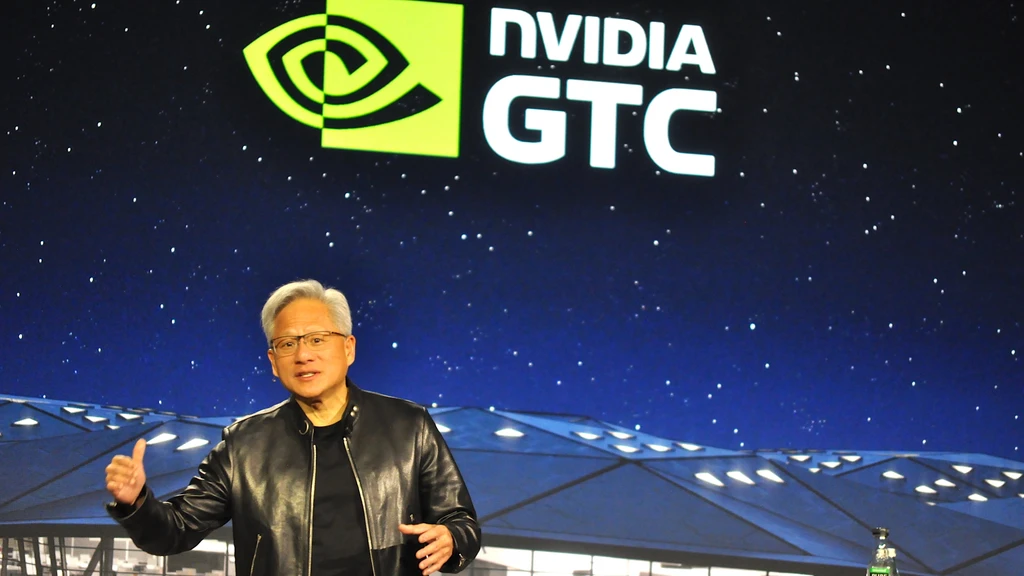
Nvidia CEO Jensen Huang confirmed the company has received purchase orders from Chinese customers and is restarting manufacturing for the region, signaling a reversal of earlier U.S. export restrictions on its H200 chips.
Speaking at Nvidia’s GTC conference in San Jose, Huang said, “Our supply chain is getting fired up,” as the company eyes at least $1 trillion in chip orders through 2027.
He expressed concern over geopolitical risks tied to Taiwan, where Nvidia is set to become TSMC’s largest customer. “I am 100% certain that the world will depend on Taiwan for a very long time,” Huang stated.
Nvidia also unveiled its Groq 3 language processing unit-manufactured by Samsung in South Korea-as a cornerstone of its AI inferencing strategy. Paired with the Vera Rubin NVL72 rack, the technology could boost projected revenues by 25%, potentially lifting the $1 trillion forecast to $1.25 trillion.
The company expanded its robotics ambitions with an Open Physical AI Data Factory Blueprint to accelerate autonomous vehicle and robot development. Though automotive currently accounts for just 1% of revenue, Huang compared its potential to CUDA’s early days: “It turned out that everything we did in the beginning cost us a lot of money and generated nothing.”
On AI ethics, Huang emphasized legal compliance and reliability: “AI shouldn’t break the law, AI should not promise functionality it does not have.” He advocated for secure, high-speed AI agents to protect users in critical systems.