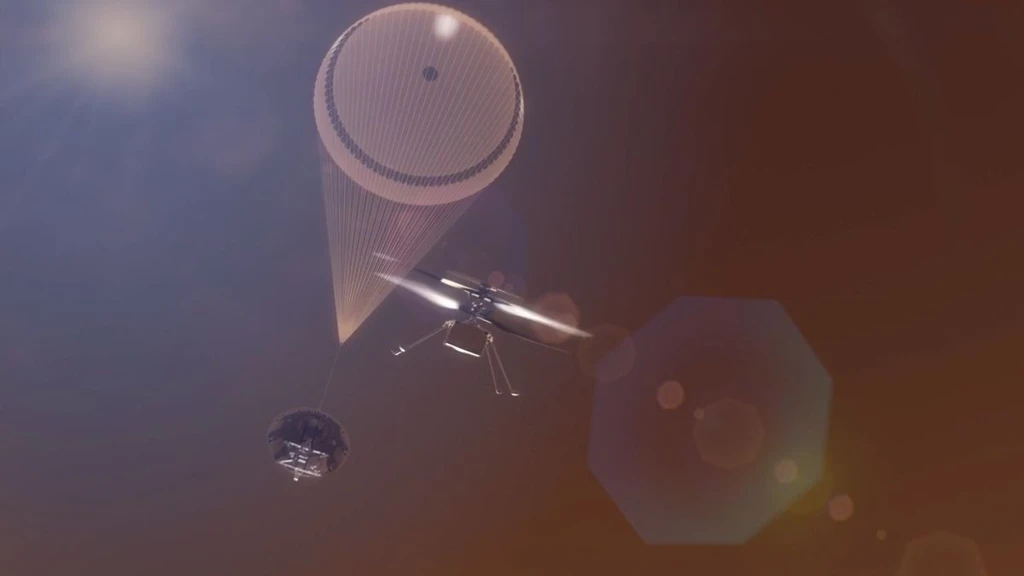
NASA's next-generation Mars helicopter rotors have broken the sound barrier in ground tests, unlocking the potential for heavier scientific payloads on future missions.
The new two-blade and three-blade designs were spun to speeds above Mach 1 in a special chamber at the Jet Propulsion Laboratory that simulates the thin Martian atmosphere. The fastest runs hit Mach 1.08, well above the 0.7 Mach limit that constrained the Ingenuity helicopter.
"We thought we'd be lucky to hit Mach 1.05, and we reached Mach 1.08 on our last runs," said aerodynamicist Shannah Withrow-Maser from NASA's Ames Research Center. "These next-gen helicopters are going to be amazing."
By pushing rotors to supersonic speeds, engineers can increase lift by about 30%, allowing the next helicopters to carry more scientific instruments than Ingenuity.
The testing is part of the SkyFall project, which plans to send three helicopters to Mars to scout potential human landing sites and map subsurface water ice. The launch is expected by the end of 2028.