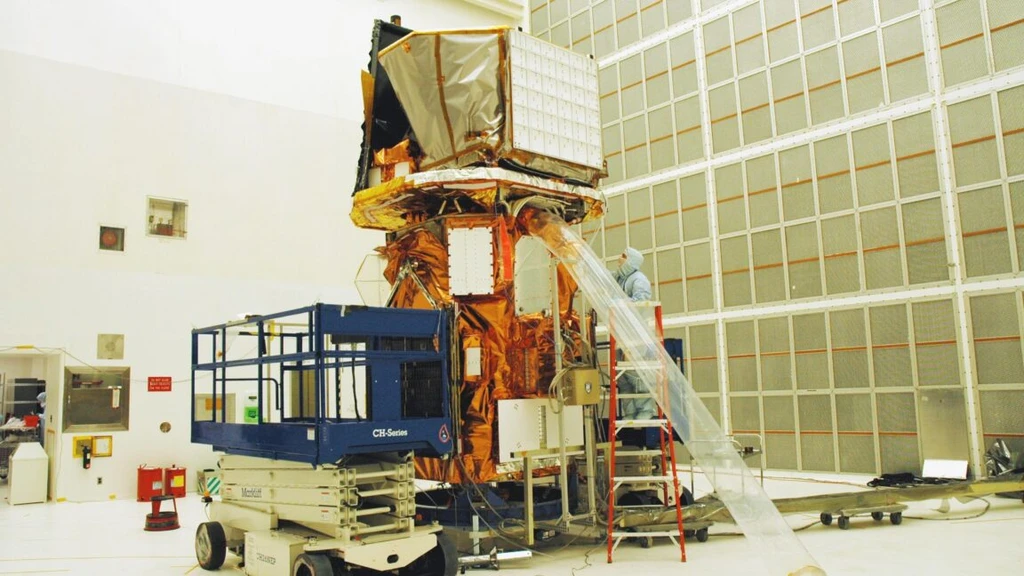
BROOMFIELD, Colorado-The 21-year-old Neil Gehrels Swift Observatory is falling from orbit and could burn up in Earth’s atmosphere by late summer without intervention. NASA has hired Katalyst Space Technologies to execute a first-of-its-kind commercial rescue.
Katalyst must launch its robotic spacecraft, Link, by June 1 to reboost Swift before it drops below 200 miles. At that altitude, atmospheric drag would make docking too risky. The $30 million mission is fast-tracked, with development, testing, and assembly happening simultaneously.
Swift was never designed for servicing. It detects gamma-ray bursts-cosmic events from dying stars or neutron star collisions-and remains irreplaceable despite its age. No other U.S. satellite matches its rapid-response capability.
Katalyst’s engineers face uncertainty about Swift’s current condition. Decades in space have likely degraded surface materials, making capture difficult. The rescue craft uses three adaptive robotic arms designed to grip whatever viable structure remains.
The mission rides on the Pegasus XL rocket-the last of its kind-launched from Kwajalein Atoll for optimal orbital alignment. Falcon 9 was too costly and inflexible for this narrow window.
This effort marks a shift from traditional government-led programs to lean, risk-tolerant commercial space solutions. Success could redefine satellite longevity and in-orbit servicing.