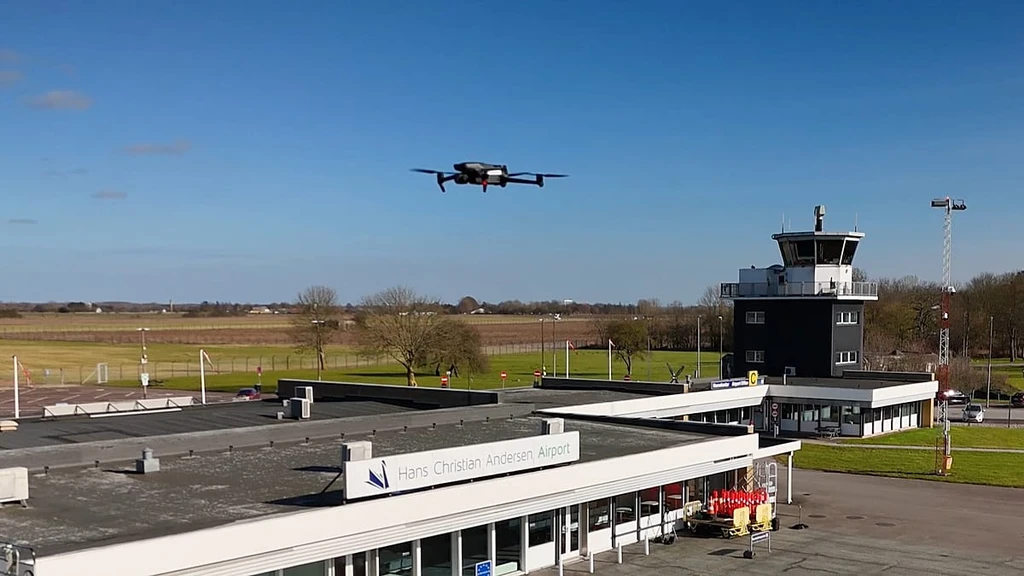
Odense International Airport (HCA) in Denmark is uniquely managing a 1,900 km² airspace for both traditional aircraft and drones. This initiative, part of the NextGen Innovation project, positions the Danish International UAS Centre as a premier European hub for drone experimentation for commercial and defense applications.
In an era of geopolitical shifts, coordinating diverse aircraft and drones is critical for defense, urgent transport, and infrastructure surveillance. August Mader's company, AirPlate, has deployed a "drone box" at the airport, featuring eight sensors capable of detecting drones over fifteen kilometers away.
The airport hosts approximately 15 specialized companies. Among them is the UAS Drone Centre at the University of Southern Denmark (SDU-UAS), which analyzes project data and collaborates with these firms. Their motto is "Experiment, crash and learn." Researcher Jes Hundevadt Jepsen highlights the platform's adaptability, allowing for rapid integration of new components and swift repairs after crashes. He emphasizes the vital collaboration between academia and industry to advance drone technology.
The project's total budget exceeds €9 million, with 40% funded by the European Union's cohesion policy. The global drone market, currently valued at €59 billion, is projected to surpass €127 billion by 2036, underscoring the growing importance of such integration projects.