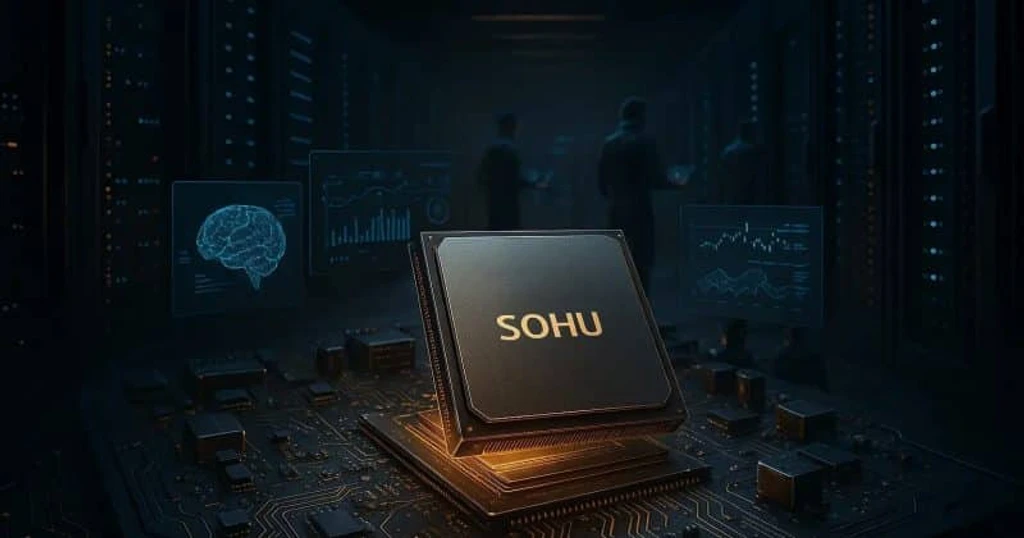
Chip startup Etched has emerged from stealth, not with a roadmap, but with a purpose-built solution and a billion-dollar order book. On June 30, the company announced its Sohu chip, an application-specific integrated circuit (ASIC) designed exclusively for transformer-based large language model inference.
The company claims its rack-scale system delivers state-of-the-art throughput, latency, and power efficiency. Fabricated on TSMC’s N4P process, the design achieved first-pass silicon success, a rare and cost-saving milestone in semiconductor development. Preliminary customer tests have validated performance on models including Llama, DeepSeek, and Qwen.
Etched is not merely shipping samples. The startup reports over $1 billion in signed customer contracts, with its inaugural rack shipments slated for this summer. The company has outlined an aggressive trajectory to scale toward gigawatt-capacity production by 2027, a scale typically associated with major hyperscalers.
To fuel this growth, Etched has secured $800 million in total funding, recently closing a $500 million round at a $5 billion valuation. Its investor base includes quantitative trading firm Jane Street, Peter Thiel, and Turing Award winner Geoffrey Hinton. A team of over 400 engineers, many drawn from Nvidia and TSMC, is driving the effort.
The launch directly targets the economics of AI deployment, where inference costs now rival training expenses in strategic importance. The primary challenge for Etched remains software adoption, as customers must weigh the chip's massive performance efficiency against the entrenched Nvidia CUDA ecosystem.