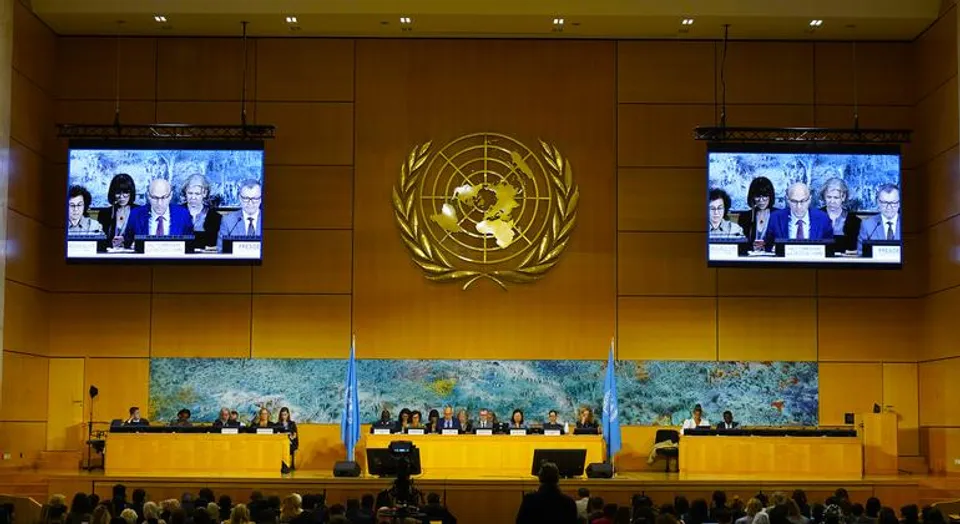
Secretary-General António Guterres declared human rights are under a "full-scale attack," often perpetrated by those in power, amidst escalating global conflicts. Speaking at the Human Rights Council, he urged a firm stance on rights despite "dizzying geopolitical uncertainty" in Gaza, Myanmar, Ukraine, and Sudan.
On the fourth anniversary of Russia's full-scale invasion of Ukraine, Guterres called for an end to the bloodshed, noting over 15,000 civilian deaths. UN human rights chief Volker Türk emphasized that rights and justice must be central to any peace agreement.
UN General Assembly President Annalena Baerbock echoed these concerns, stating that "silence has consequences" and human rights are "not a spectator sport." She cautioned against the slow erosion of fundamental rights and commitments, citing the plight of Afghan women and the dismissal of international standards.
Baerbock also highlighted the abduction of Ukrainian children as a war crime, referencing those separated from families since 2014.
Guterres warned that the two-State solution for the Israeli-Palestinian conflict is being "stripped away" and unacceptable. He criticized the impunity of aggressors and the disregard for international law, stating that mass suffering is excused and humans are used as bargaining chips.
In his final address before his term ends, Guterres addressed mounting debt, despair, and accelerating climate chaos, particularly impacting vulnerable nations. He also noted that artificial intelligence is increasingly used to suppress rights and deepen inequality.
Türk stressed the need to call out violations of international law "regardless of the perpetrators" and announced the upcoming launch of his Office’s Global Alliance for Human Rights, a collaboration of states, businesses, and civil society to defend universal rights.