In 2019, astronomers recorded a distant star in the Large Magellanic Cloud flaring for about an hour-too long for a stellar flare, too brief for a supernova. Now, a team led by Renee Key of Swinburne University suggests it could be a primordial black hole, about three times the mass of Earth's Moon.
Called Phoebe, this object would have an event horizon the size of a period. If confirmed, it would be the first direct evidence of these theoretical black holes formed just after the Big Bang.
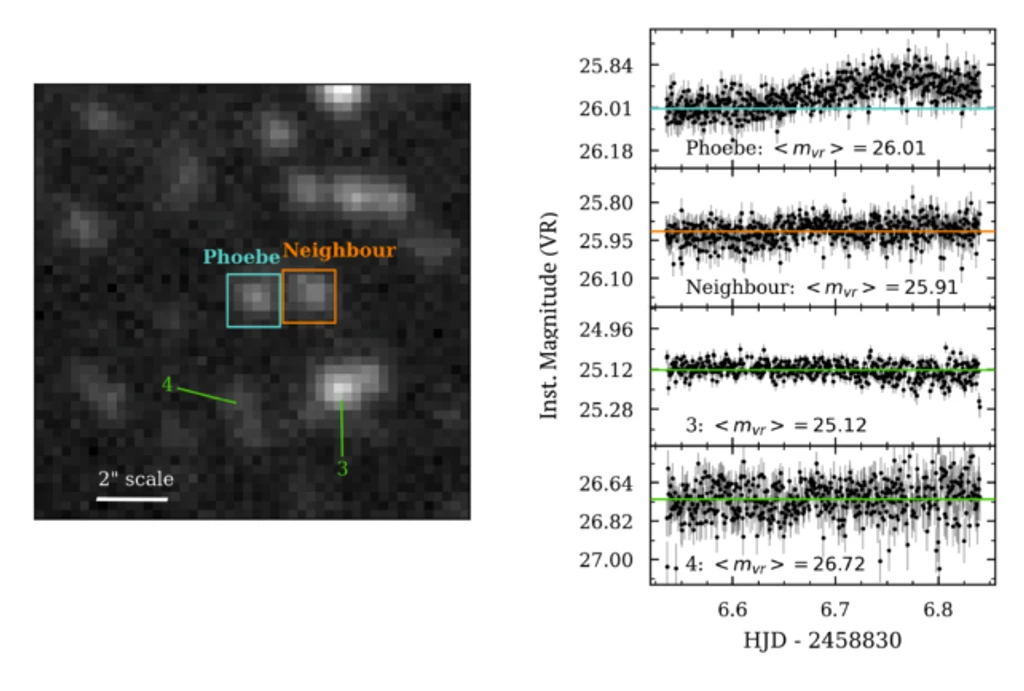
The team modeled multiple scenarios, ruling out instrument glitches and stellar fluctuations. Their calculations show Phoebe is most likely a black hole in the Milky Way's dark matter halo, about 59,630 light-years away.
This discovery reignites the debate over previous primordial black hole candidates from Subaru data. Key's team says it supports those findings, but a more sensitive telescope is needed for confirmation.