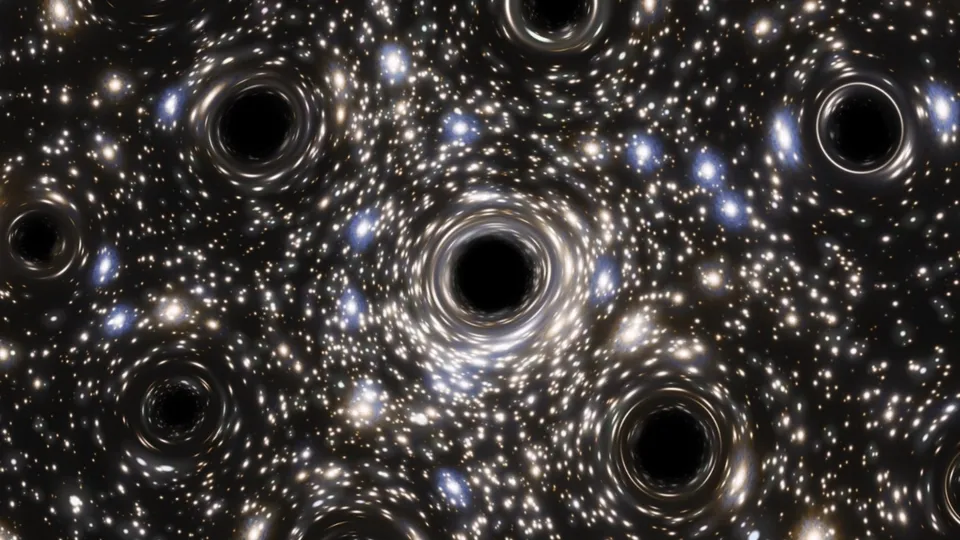
Data from the Gaia space observatory has revealed a surprising discovery within the Palomar 5 star cluster: a dense swarm of more than 100 stellar-mass black holes. This cluster, a stellar stream stretching 30,000 light-years and located 80,000 light-years away, is providing unprecedented insights into galactic formation.
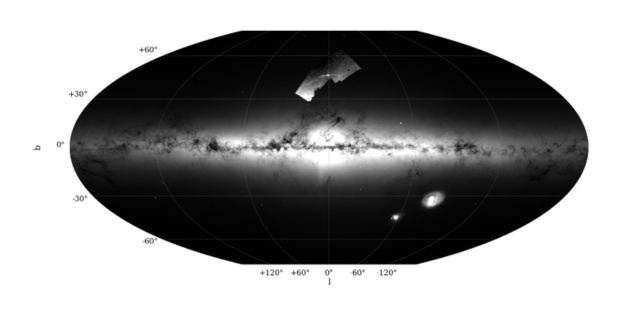
Globular clusters like Palomar 5, often considered "fossils" of the early Universe, typically contain vast numbers of ancient stars. However, Palomar 5 exhibits a unique, wide distribution of stars and an exceptionally long tidal stream. Researchers utilized detailed N-body simulations to model the cluster's evolution.
These simulations indicated that a substantial population of black holes within Palomar 5 could explain its current configuration. Gravitational interactions with these black holes would have propelled stars out of the cluster, forming the observed tidal stream. The findings suggest that black holes constitute over 20 percent of the cluster's total mass, with each black hole roughly 20 times the mass of the Sun.

Future simulations predict that in approximately one billion years, Palomar 5 will dissolve entirely, leaving behind a cluster composed solely of black holes. This discovery offers a new method for estimating black hole populations in star clusters, crucial for understanding phenomena like binary black hole mergers.