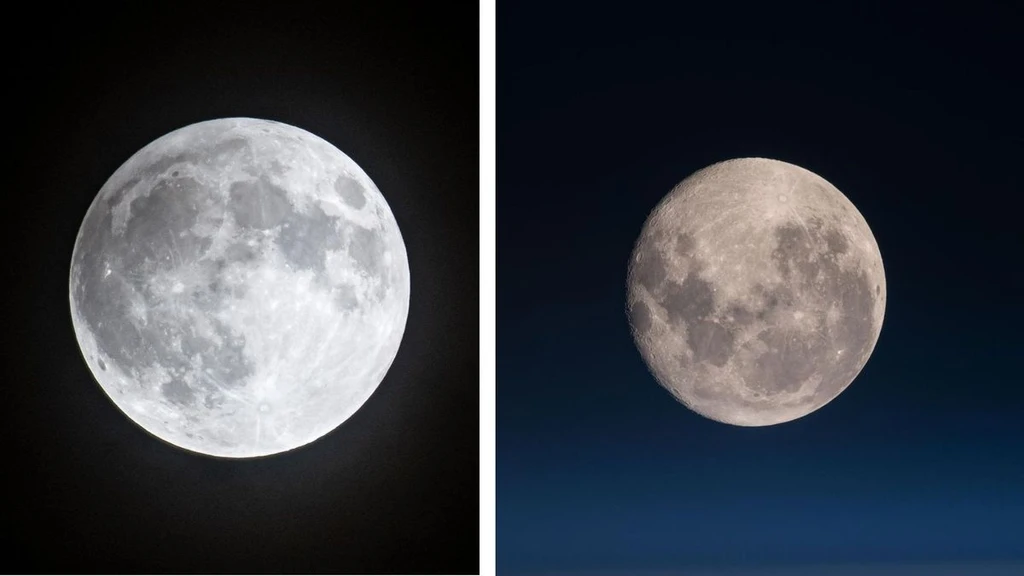
The moon appears rotated by 180 degrees from the Southern Hemisphere compared to the Northern Hemisphere.
From the North Pole, the Tycho crater is visible at the moon's bottom. From the South Pole, it appears at the top. In temperate regions, the moon's orientation shifts significantly based on latitude. An observer in Wellington, New Zealand, sees the moon rotated nearly 100 degrees counterclockwise compared to someone in Los Angeles. This phenomenon occurs because our orientation to space-based objects changes with latitude, offering opposite vantage points of the moon from opposite ends of Earth.
Despite these orientation changes, all locations on Earth observe more or less the same face of the moon due to its synchronous rotation, where it completes one rotation on its axis in the same time it orbits Earth. However, subtle wobbles, known as librations, cause slight variations in the visible face.
Lunar phases also differ between hemispheres. Near the equator, the crescent moon can appear like a boat. Observers in the Northern Hemisphere see the moon grow and shrink from right to left, while the opposite is true in the Southern Hemisphere. This difference stems from the distinct perspectives of each hemisphere. Calendar symbols designed from a Northern Hemisphere viewpoint may appear inaccurate in the South.
Additionally, the moon's orientation can appear to rotate as it traverses the night sky. At the equator, the moon's face can seem to rotate by 180 degrees over an evening. This effect is less pronounced at higher latitudes where the moon does not pass directly overhead.