
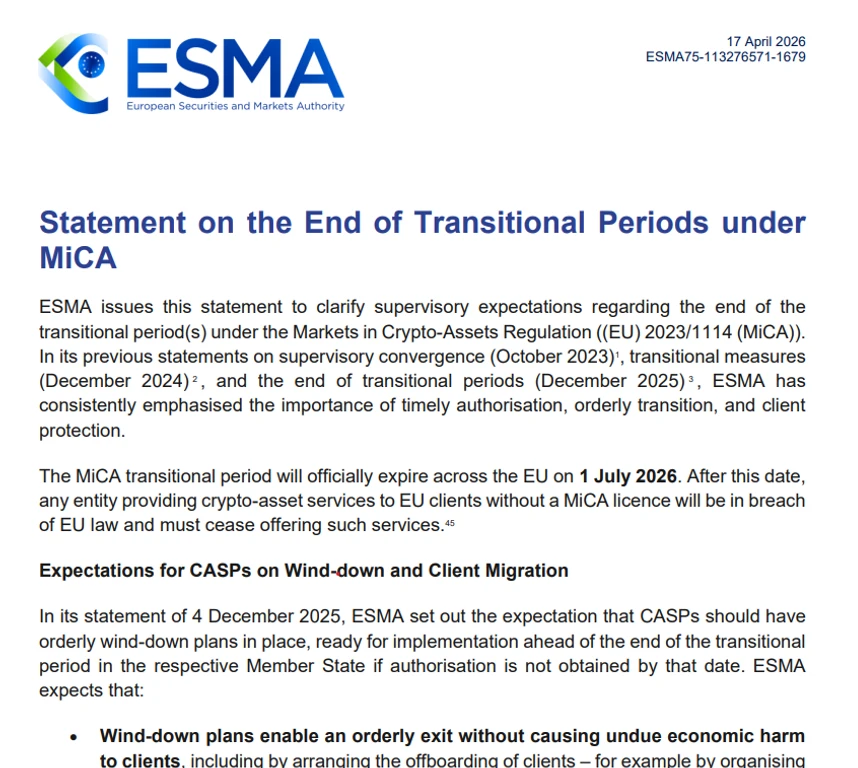
A hard deadline is approaching for crypto firms operating in the European Union. On July 1, the transitional period for the Markets in Crypto Assets Regulation (MiCA) ends. From that date, any crypto asset service provider (CASP) not holding a MiCA license must stop serving EU clients.
According to the European Securities and Markets Authority (ESMA), non-authorized entities will not be allowed to operate and must implement wind-down plans. This could force some platforms to suspend operations while their applications are still under review, potentially affecting millions of users.
In France, 19 CASPs are currently authorized, with about 25 applications pending. The Autorité des marchés financiers (AMF) warns that unauthorized services are a criminal offense, punishable by up to two years in prison and a €30,000 fine.
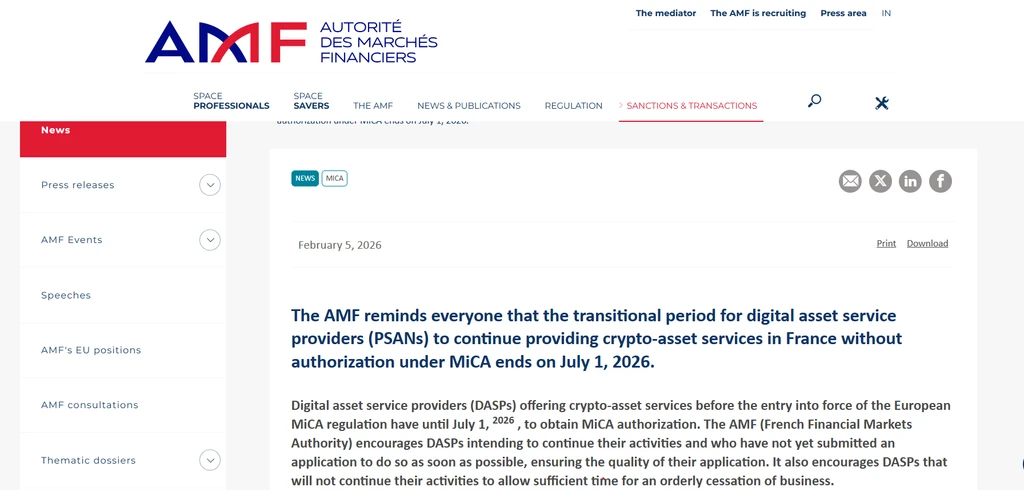
Germany has set a June 30 licensing deadline for firms operating under prior exemptions. Austria chose not to extend grandfathering, meaning no exchanges operate without a license there. The Finanzmarktaufsicht (FMA) has licensed nine CASPs so far, with a significant volume of new MiCA applications.
Legal experts warn that a pending application offers no protection. Niall Esler of law firm Walkers states that firms serving EU clients without authorization after the deadline will be operating unlawfully.
Data from OKX Europe reveals that of 18.5 million crypto app downloads in Europe over the past year, 41% were to exchanges not on the MiCA-authorized register. CEO Erald Ghoos estimates that roughly 60% of European crypto users are actively engaging with non-authorized platforms.
Major exchanges like Bitget and Binance are still awaiting approval. Bitget expects a decision in Q2 2026, while Binance's application in Greece remains pending.