
A Russian ruble-backed stablecoin, A7A5, has processed over $110 billion in cumulative onchain transactions despite Western sanctions, according to blockchain security firm CertiK. The stablecoin now controls approximately 43% of the global non-US dollar stablecoin market, with its holder count more than doubling from 13,000 to 29,000 wallets between February 2025 and May 2026.
CertiK describes A7A5 as one of the clearest examples of a sanctions-evasion stablecoin ecosystem, linking it to Russian cross-border settlement companies. The growth underscores the limitations of Western sanctions against blockchain-based payment systems, including the European Union's 19th sanctions package adopted in October 2025, which prohibited transactions involving A7A5 starting November 12.
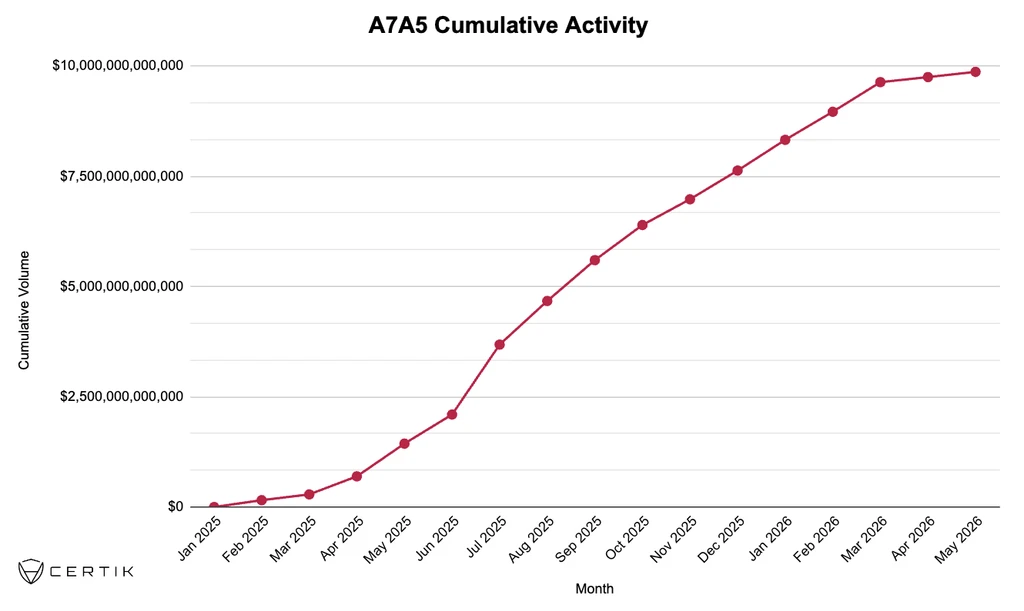
A7A5 was issued in January 2025 by Old Vector LLC, a Kyrgyz entity acting on behalf of Russian cross-border settlement firm A7 LLC, co-owned by Moldovan-Russian oligarch Ilan Shor and Russian state-owned defense lender Promsvyazbank. Russian authorities have since recognized A7A5 under the country's digital financial asset framework.
The stablecoin recorded $11.2 billion in trading volume on A7A5/RUB pairs and $6.1 billion on A7A5/USDT pairs, primarily through the exchange Grinex, successor to Garantex, a platform previously used for laundering funds tied to ransomware groups and North Korean-linked hackers.
CertiK analyst Jonathan Riss says A7A5 was designed without a centralized kill switch, meaning only its Russian and Kyrgyz developers control wallet and fund freezes. Its reserves sit in Central Asian and Russian banking networks, beyond Western reach. The stablecoin also uses decentralized finance liquidity pools like Curve and Uniswap to avoid centralized exchange freezes.
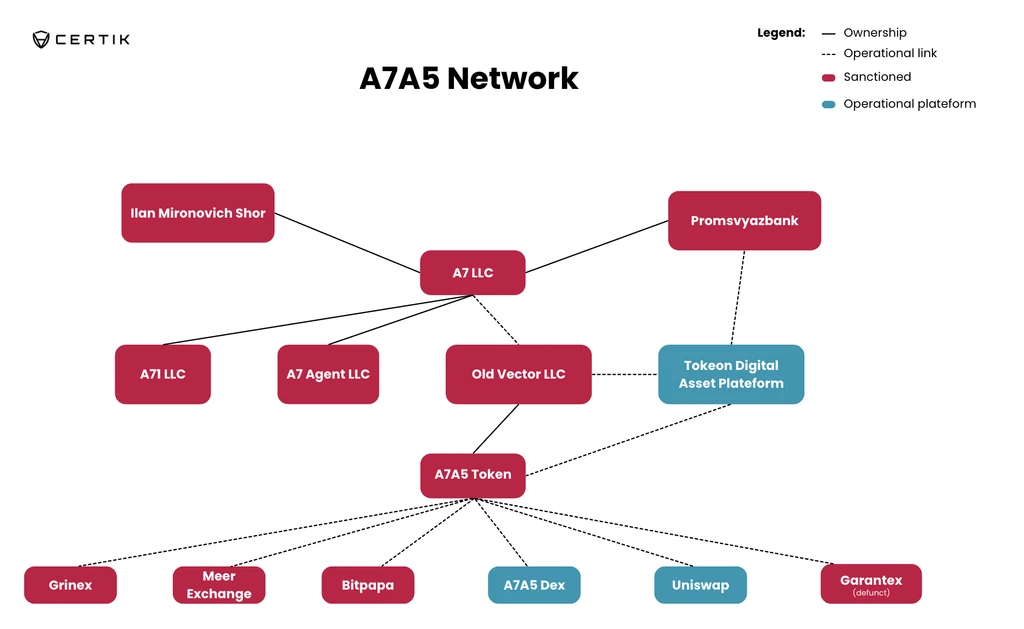
Ilan Shor owns 51% of A7 LLC. A former Moldovan parliament member, Shor was convicted in 2017 for involvement in a $1 billion bank theft. He fled to Russia in 2019 and was sentenced in absentia to 15 years in prison in 2023.