
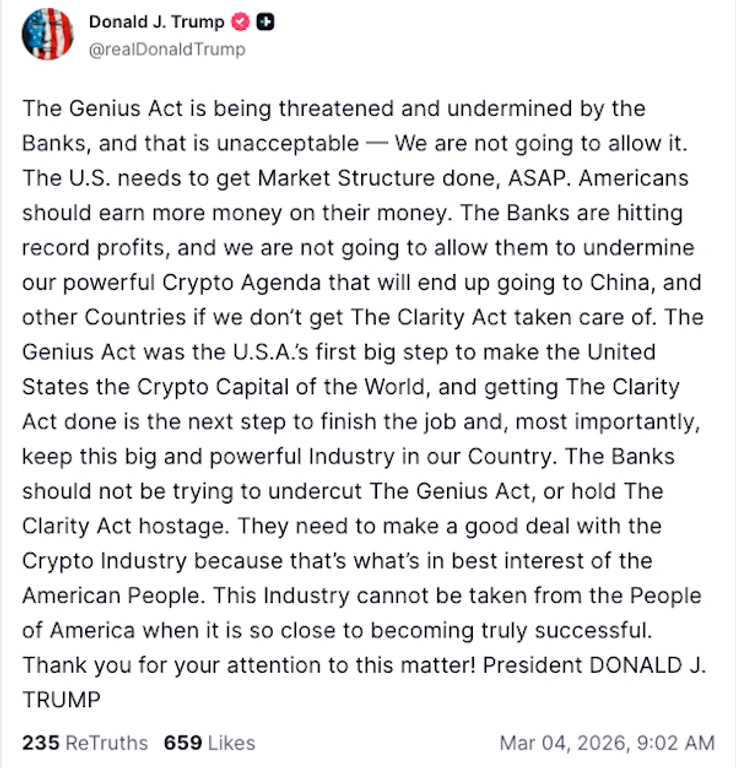
Former President Donald Trump has publicly criticized U.S. banks, accusing them of impeding the advancement of a crucial crypto market structure bill in the Senate, particularly concerning stablecoin yield payments. Trump stated on his Truth Social platform that the GENIUS Act, passed by Congress to regulate stablecoins, is being threatened by banks, calling it "unacceptable." He urged for swift action on market structure legislation, asserting that banks, despite record profits, are undermining a "powerful Crypto Agenda" that could otherwise benefit the U.S. instead of China and other nations.
The GENIUS Act, championed by Trump, provides a regulatory path for stablecoin issuers but prohibits them from directly offering yield payments. However, third-party platforms like crypto exchanges can still provide yield to users holding stablecoins. Banking groups argue this constitutes a legal loophole and are lobbying for a complete ban on all stablecoin yield payments within the Senate's bill. The House previously passed its version, the CLARITY Act, in July.
Trump emphasized that banks should not obstruct the GENIUS Act or hold the CLARITY Act hostage, advocating for a beneficial agreement between the banking sector and the crypto industry for the sake of American interests. Crypto executives and lobbyists have opposed the banks' push for a yield payment ban, with major player Coinbase withdrawing support for the legislation in January due to this issue, leading to the Senate Banking Committee postponing a review of the bill. Banking groups have expressed concerns that stablecoin yield payments could divert funds from traditional bank accounts, potentially destabilizing the banking system.
Representative French Hill suggested that if the Senate struggles to advance its own bill, it should consider adopting the House's CLARITY Act. Hill reiterated that the House bill defines stablecoins as payment devices on a blockchain, not investment devices, and would not allow for direct interest payments.