A new study investigated the accuracy of Artificial Intelligence (AI) in measuring kidney stone volumes compared to semi-automated methods, aiming to determine if AI can better predict stone-free status after surgery. Researchers analyzed 171 CT scans, comparing stone volumes calculated by two semi-automated segmentation applications (QSAS and 3D-Slicer) requiring manual annotation, with volumes generated by a fully automated AI program.
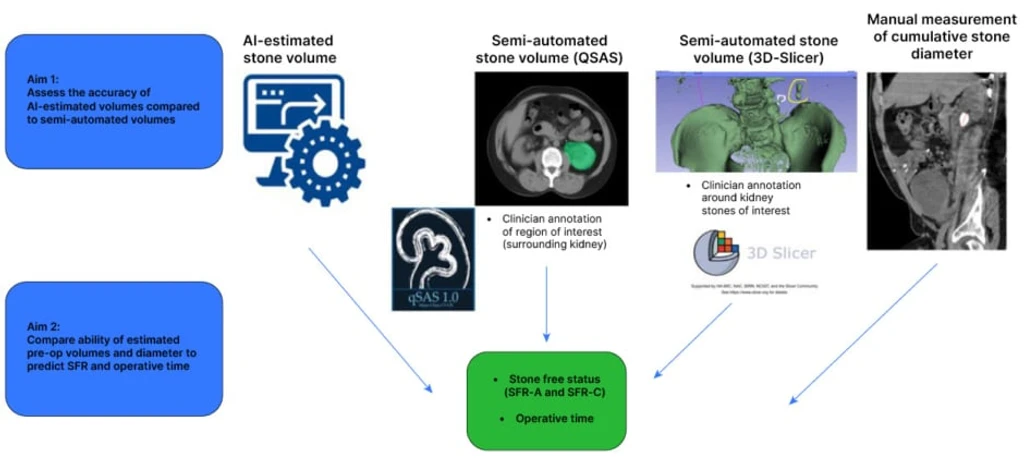
The AI-calculated volumes showed strong linear correlations with both semi-automated methods, with R values of 0.95 for both QSAS and 3D-Slicer. Post-operative scans maintained strong correlations as well. The AI model demonstrated 85.7% sensitivity and 88.9% specificity in identifying patients who were stone-free after surgery (SFR-Grade A), with errors primarily associated with small, low-attenuation stones and anatomical variations.
While pre-operative volumetric measurements did not outperform cumulative stone diameter in predicting stone-free status, semi-automated volumes from 3D-Slicer and QSAS explained more variation in operative time than diameter or AI-estimated volumes. The study concludes that the fully automated AI method is highly accurate and offers an efficient, clinician-annotation-free option for estimating stone burden.