A recent study explored how Artificial Intelligence can amplify the benefits of high-relaxivity contrast agents in brain MRI. Researchers aimed to see if a Deep Learning (DL) based contrast boosting algorithm could further enhance lesion visualization and image quality while using reduced doses of Gadopiclenol.
The retrospective study analyzed MRI scans from 20 patients who received Gadopiclenol at a reduced dose of 0.05 mmol/kg. Pre-contrast and standard post-contrast images were processed using an FDA-cleared DL algorithm to create contrast-boosted (CB) images. Quantitative metrics like contrast-to-noise ratio, lesion-to-brain ratio, and contrast enhancement percentage (CEP) were assessed.
Results showed a marked improvement on CB images compared to standard post-contrast images. The contrast-to-noise ratio increased by 314%, the lesion-to-brain ratio by 118%, and CEP by 335%. These advancements suggest that CB images with a reduced dose of Gadopiclenol are quantitatively comparable to standard doses of conventional agents.
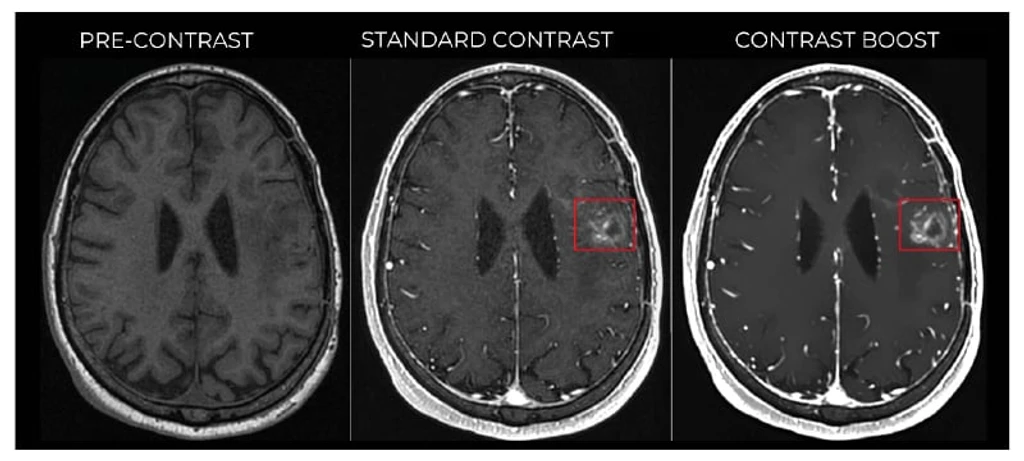
The study concluded that the DL algorithm significantly enhances image quality and lesion conspicuity when combined with Gadopiclenol at a reduced dose. This synergy offers a strategy for lowering gadolinium doses without compromising diagnostic performance. Limitations include the study's retrospective design and small sample size.