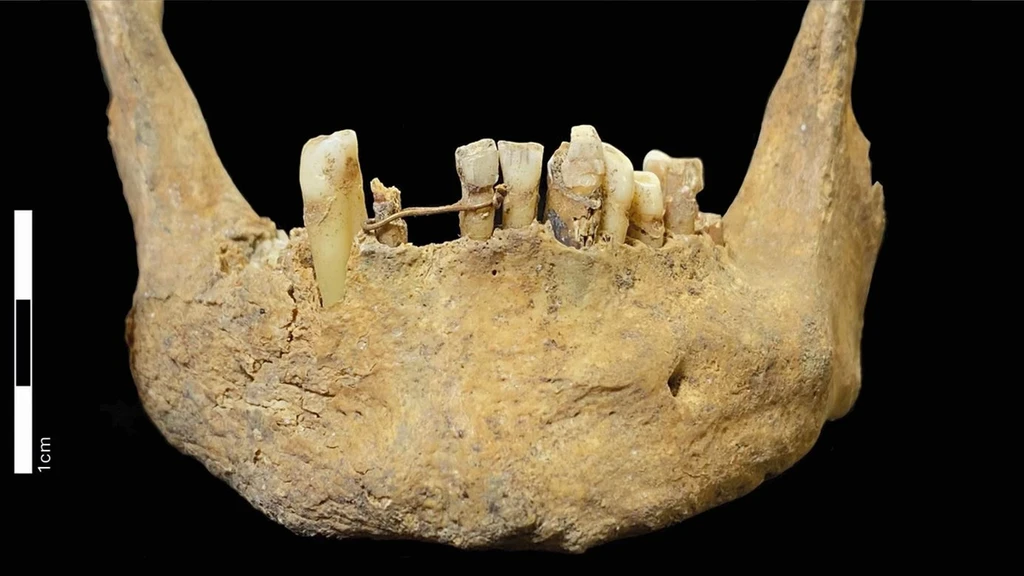
A man's lower jaw recovered from a medieval church in Aberdeen reveals the oldest known use of a dental bridge in Scotland, a new study finds. The gold wire, called a ligature, was installed around two teeth about 500 years ago to span the gap created by a lost tooth.
The lower jaw preserved nine teeth, with evidence that one of the man's incisors had been lost during life. The man had hardened plaque, cavities, and periodontal disease. Although poor oral health was common in the late medieval period, the gold wire installed around two tooth roots was noteworthy.
A 20-karat-gold wire encircled the lower right lateral incisor and the lower left central incisor, spanning the gap caused by the loss of the lower right central incisor. The wire was looped around one tooth root and secured by a twisted knot around the other.
Rebecca Crozier, a bioarchaeologist at the University of Aberdeen and co-author of the study, said the wire had been rubbing against one tooth root for some time. The wire was likely holding the actual lost tooth or a prosthetic tooth in place.
Dentistry was not organized as a profession until the 19th century, but barbers, healers, and even jewelers performed semiskilled dental procedures long before then. The researchers wrote that the underlying reasons for this procedure were likely multifaceted, including regaining chewing functionality and improving appearance.
In this period, a person's appearance and perceived health were linked to their moral character, so those who could afford it sought dental treatments. It is likely the jeweler who made the gold wire also installed it.
Crozier noted that actions such as biting into something hard would have been problematic for the man.