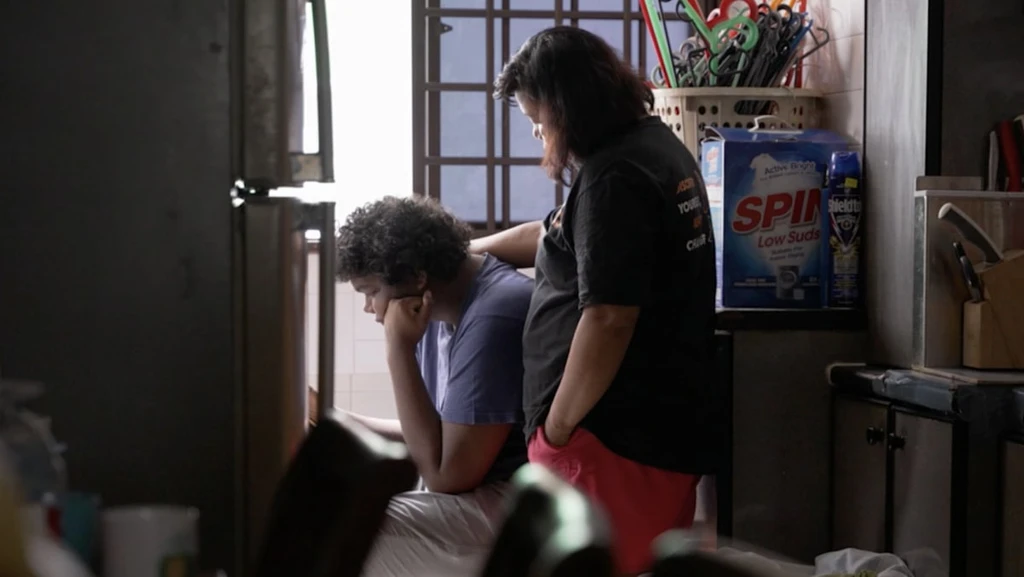
In Singapore, a growing number of young people are retreating into their homes, refusing school and social contact. This phenomenon, known as hikikomori, is moving from a Japanese stereotype to a local crisis.
One case worker's six-month effort was needed just to begin engaging with Danzel, a young man who withdrew after bullying. His world shrank to his family's flat, leading to physical deterioration and extreme depression.
Social workers now report a sharp increase in cases. Fei Yue Community Services has seen its caseload jump from 20 to 111 in six years. Experts point to bullying, family stress, and a complex world as root causes, with withdrawal becoming a coping mechanism that hardens into a way of life.
Danzel covering his head after feeling overwhelmed by the film crew during a visit to the Institute of Mental Health.
The impact extends to families. For one father, Chuah Soon Ann, communication with his isolated teenage son is a series of guesses. Support groups provide some relief, but the emotional fatigue for families and social workers is profound.
Recovery is slow and nonlinear. For some, it means physiotherapy or studying a single subject. For others, like Shaista, it's a goal to eventually travel alone. Artist Goay Zhen Yi found a way to share his story publicly through a diorama displayed at a national festival.
Like many other hikikomori, Shaista Qistina says she has no real-life friends.
Officials, including Health Minister Ong Ye Kung, are now engaging with the issue. The key is recognizing early signs like school absenteeism before isolation deepens. The minister advocates for a societal approach, suggesting that sometimes the solution is to 'do less'-judge less and force less-to rebuild trust.