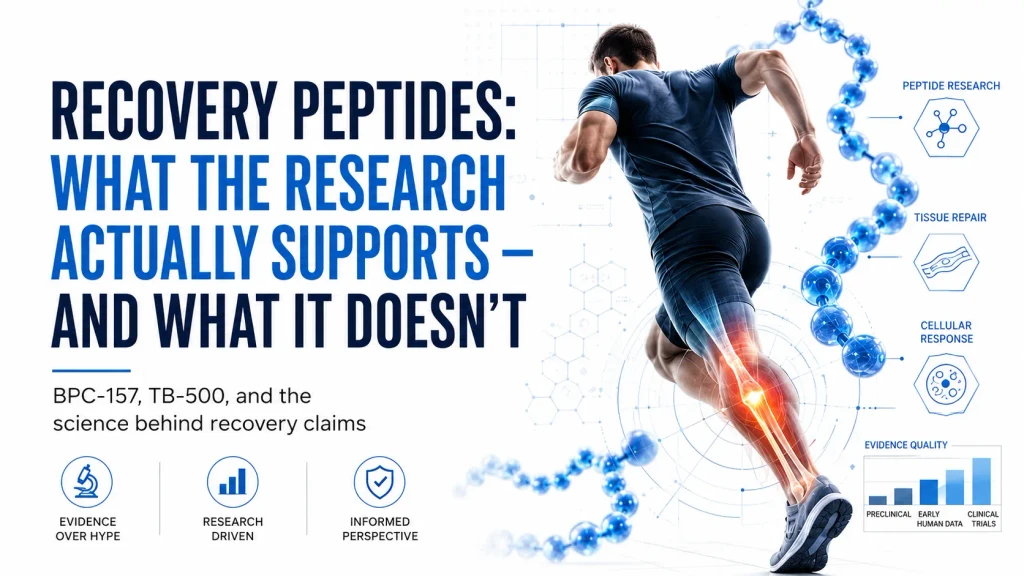
Peptides are short chains of amino acids that act as signaling molecules. In the recovery context, synthetic versions like BPC-157 and TB-500 are studied for their interaction with repair mechanisms such as angiogenesis and cell migration.
BPC-157, a synthetic peptide derived from a human gastric juice sequence, has a large preclinical record. Researchers at the University of Zagreb have reported accelerated healing in rodent tendons, ligaments, and muscle through pro-angiogenic activity.
TB-500 is a synthetic fragment of Thymosin β4, a naturally occurring peptide central to wound closure and cell migration. The underlying biology is real, though the strongest evidence concerns the full-length Thymosin β4, not just the TB-500 fragment.
However, the evidence stops at the preclinical stage. Robust, peer-reviewed human clinical trials are essentially absent. The history of pharmacology shows promising animal results frequently fail to translate to humans.
Both compounds are on the World Anti-Doping Agency's prohibited list. For any competitive athlete, a positive test carries severe consequences, classifying these substances as unapproved research compounds rather than supplements.
A critical problem upstream of the pharmacology is verification. As unregulated research chemicals, the contents of a vial are not guaranteed. The benchmark for credibility is a certificate of analysis from an independent third-party lab confirming both purity (HPLC) and identity (mass spectrometry) for a specific batch.
The fundamentals remain the most proven recovery tools: sleep, nutrition, progressive overload, and sensible load management. A smart approach pairs confidence in these settled sciences with curiosity about the frontier. Run every new claim through three filters: the strength of the evidence, independent verification of the product, and the total cost of being wrong.