
A new robotic system integrating ultrasound navigation aims to improve precision in percutaneous access procedures, essential for operations like kidney stone removal, biopsies, and ablations. Traditional methods often rely on operator skill and image guidance, leading to variability in accuracy.
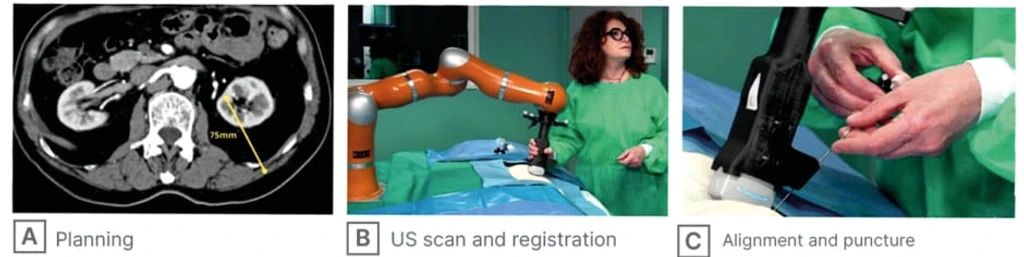
The system combines a collaborative robot with an ultrasound probe and needle guide. Surgeons first plan a trajectory on a CT scan. An AI neural network then segments the kidney from intraoperative ultrasound scans. This data is registered with the CT scan to map the planned trajectory precisely onto the patient. The robot then guides the needle insertion or provides real-time visual feedback for manual probe navigation.
Preliminary tests showed significant improvements. While 75% of experienced surgeons succeeded on the first attempt using freehand techniques, only 21% of novices did. With the robotic system, all participants, regardless of experience, succeeded on the first attempt. Execution times became similar between novice and experienced surgeons, and procedural failures were eliminated.
Robotic guidance also reduced probe motion and orientation deviations, lowering perceived workload. The system eliminates the need for intraoperative CT, reducing radiation exposure and providing accurate, real-time guidance.