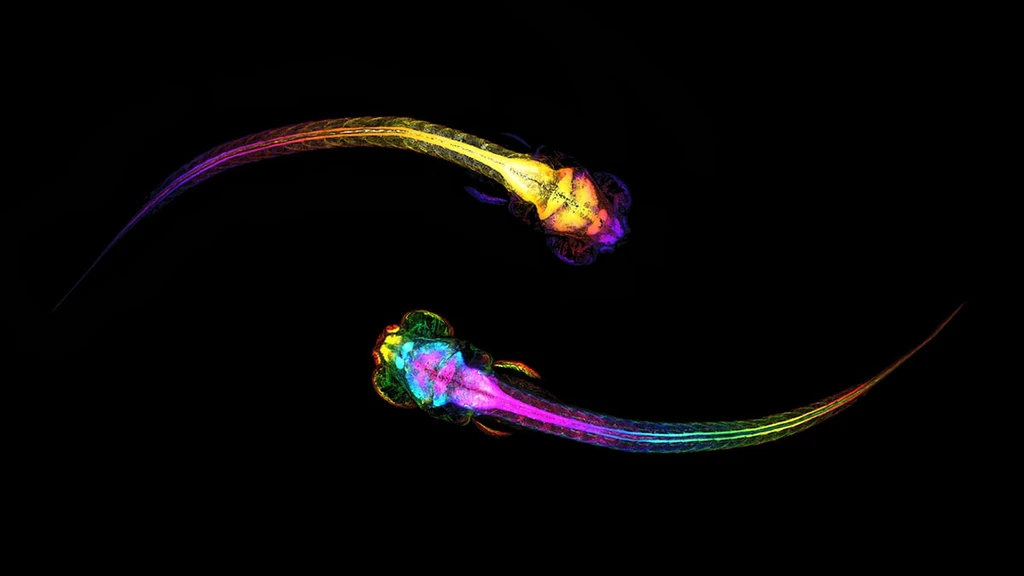
A new neuroscience study suggests your brain may be silently planning social interactions seconds before you consciously decide to move. Researchers at the Hebrew University of Jerusalem observed this phenomenon by monitoring the brains of zebrafish.
Zebrafish share key vertebrate brain structures with humans, making them powerful models for studying complex biological processes. The study revealed a distinct burst of neuron activity in the pallium-a region analogous to the human amygdala and hippocampus-that reliably predicted an impending social approach.
This neural signature was purely social. It did not appear when the fish tracked a non-living moving dot, indicating a specific mechanism for social motivation rather than general movement.
Crucially, this predictive brain activity was stronger in more social fish. When researchers used lasers to precisely ablate the specific pallial cells involved, the social approach behavior vanished entirely, confirming the circuit's critical role.
Neuroscientist Lilach Avitan explained that this signature predicts not just if an action will be social, but also gauges the individual’s social drive. The findings establish a robust framework for understanding why some individuals are inherently more social than others, potentially guiding future support for those with social difficulties. The research was published in the journal Nature Communications.