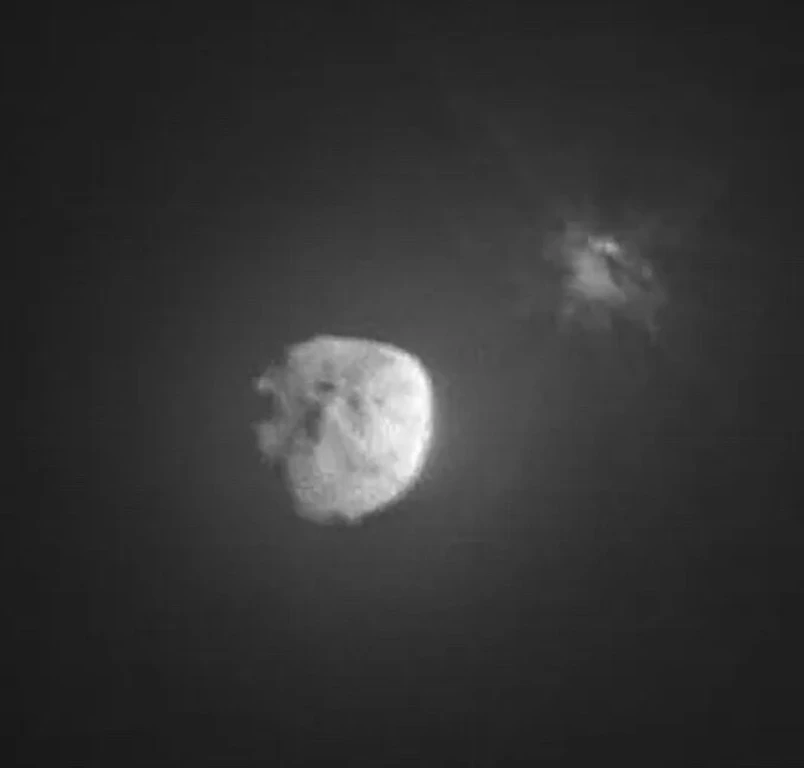
NASA’s Double Asteroid Redirection Test (DART) spacecraft successfully impacted the asteroid moonlet Dimorphos on September 26, 2022. This kinetic impact method of planetary defense was proven effective, altering Dimorphos' orbit around its parent asteroid, Didymos, by 33 minutes.
Long-term observational data now indicates DART's impact also shifted the trajectory of the entire Didymos binary system's orbit around the Sun. Researchers analyzed stellar occultations and extensive astrometric data to measure this minuscule deviation. The impact decreased the system's heliocentric velocity by approximately 11.7 micrometers per second.
The DART impact's effect was amplified by ejecta blasted from Dimorphos, acting like a rocket plume. This ejecta carried away momentum, contributing significantly to the system's overall push. Calculations revealed a momentum enhancement factor, or beta, around two, meaning the debris provided a push equal to the spacecraft's initial impact.
Analysis also revealed a density difference between the asteroids: Didymos has a density of about 2.6 tons per cubic meter, while Dimorphos is a loosely bound rubble pile with a density of 1.51 tons per cubic meter. This suggests Dimorphos formed from material shed by Didymos over billions of years.
The Didymos system poses no threat to Earth for at least the next century. The DART mission's success confirms that kinetic impacts are a viable method for deflecting binary asteroid systems, with potential for future missions to deflect larger objects.