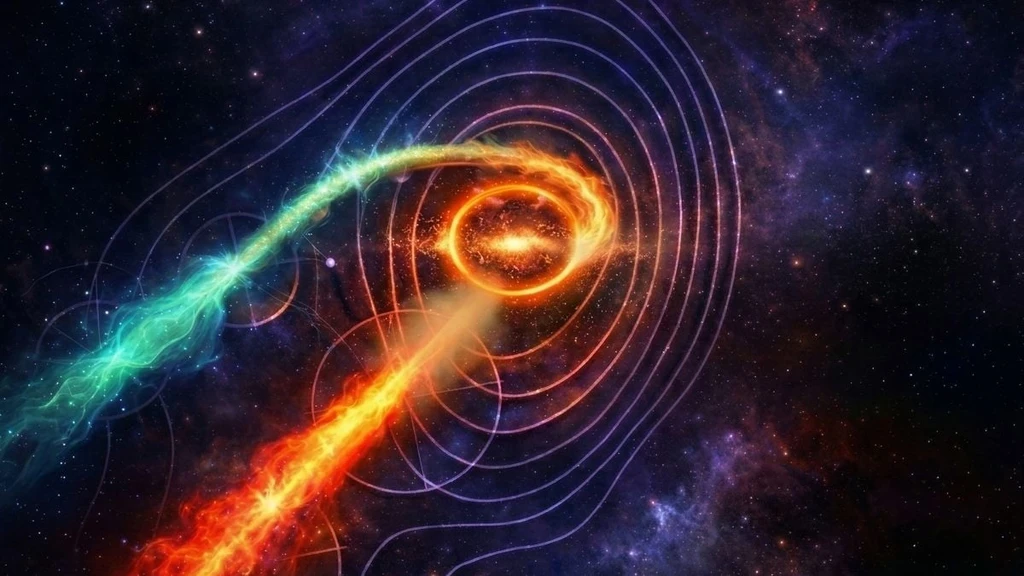
Galaxy Mrk 501, located half a billion light-years away, may be hosting two supermassive black holes on a collision course. New analysis suggests a second, fainter jet looping around the galaxy's radio core, an observation best explained by a binary black hole system. If confirmed, this could be the first direct observation of supermassive black holes merging.
Supermassive black holes, found at the heart of most galaxies, pose significant mysteries regarding their immense size. While smaller black holes form from dying stars, the growth of supermassive ones is less understood. Their mergers are theorized to generate gravitational waves, but detecting these from single events has been challenging.
Active supermassive black holes are identifiable by the bright disks of material they consume and the powerful jets of plasma they eject. Galaxies are known to collide and merge, drawing their central black holes together. Evidence of post-merger galaxies with multiple supermassive black holes in orbit has been observed.
Researchers utilized ultra-high-resolution radio telescopes to track Mrk 501's jet system over 23 years. The observed motion patterns, including a wobble consistent with a seven-year period and a faster fluctuation around 121 days, strongly suggest a binary system. The inferred orbital separation is extremely close for such massive objects, raising questions about how they overcome the "final parsec problem" which theorizes a stall in orbital decay.
If Mrk 501 hosts a binary supermassive black hole, their close proximity means a collision could occur within the next century. Advanced instruments like pulsar timing arrays could detect the resulting gravitational waves, providing an unprecedented opportunity to witness a supermassive black hole merger.