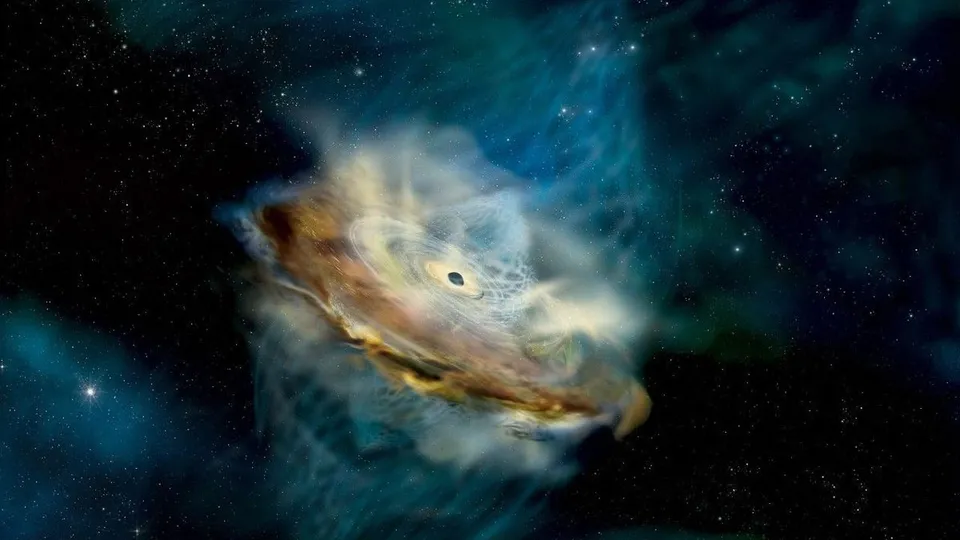
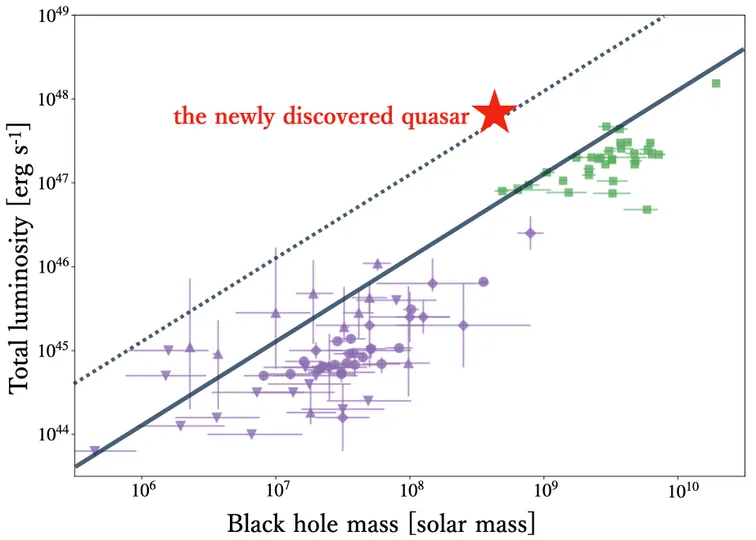
Astronomers have discovered a supermassive black hole, known as ID830, that is growing at an unprecedented rate, exceeding the theoretical cosmic 'speed limit' by thirteenfold. This ancient object from the universe's dawn is also emitting extreme X-ray and radio wave emissions simultaneously, a combination that current astrophysical models do not predict.
Black holes are typically limited in their growth by the Eddington limit, a process where outward radiation pressure from infalling material prevents excessive accretion. However, ID830 appears to be bypassing this limit, potentially by consuming matter from its equator while expelling material from its poles, or through short, intense bursts of gas intake. Researchers suggest this rapid growth is necessary to explain the existence of supermassive black holes observed in the early universe, which have grown far larger and faster than previously thought possible.
ID830's simultaneous radio and X-ray emissions are particularly puzzling. The X-rays are generated by material swirling near light speed, while the radio jets are powered by intense magnetic fields. This unexpected pairing suggests new physical mechanisms are at play in extreme accretion environments.
This discovery offers a framework for understanding early galaxy evolution. As these supermassive black holes consume vast amounts of matter, their emissions can regulate the growth of their host galaxies by heating and dispersing gas, thus suppressing star formation. ID830's behavior indicates that such rapid growth phases may be more common in the early universe than previously understood.