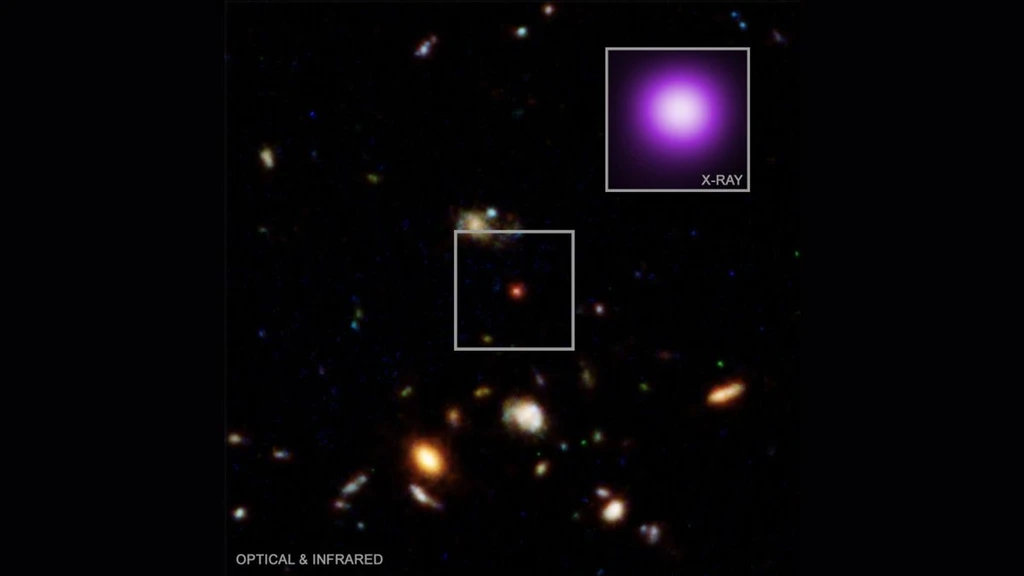
A unique black hole spewing X-rays could help astronomers finally understand the enigmatic class of objects known as "little red dots" (LRDs), which have puzzled scientists since the James Webb Space Telescope first spotted them in 2022.
Formally called 3DHST-AEGIS-12014 and nicknamed the X-ray dot (XRD), this object was hidden in a decade-old Chandra X-ray Observatory survey. Its importance emerged only after JWST observed the same cosmic field.
Unlike typical LRDs that don't emit X-rays, the XRD is a bright source. Scientists believe the X-rays may be blocked in other LRDs by thick gas cocoons. The XRD, however, has holes in its cocoon, letting X-rays escape while maintaining its reddish appearance.
"This single X-ray object may be what lets us connect all of the dots," said lead author Raphael Hviding of the Max Planck Institute for Astronomy.
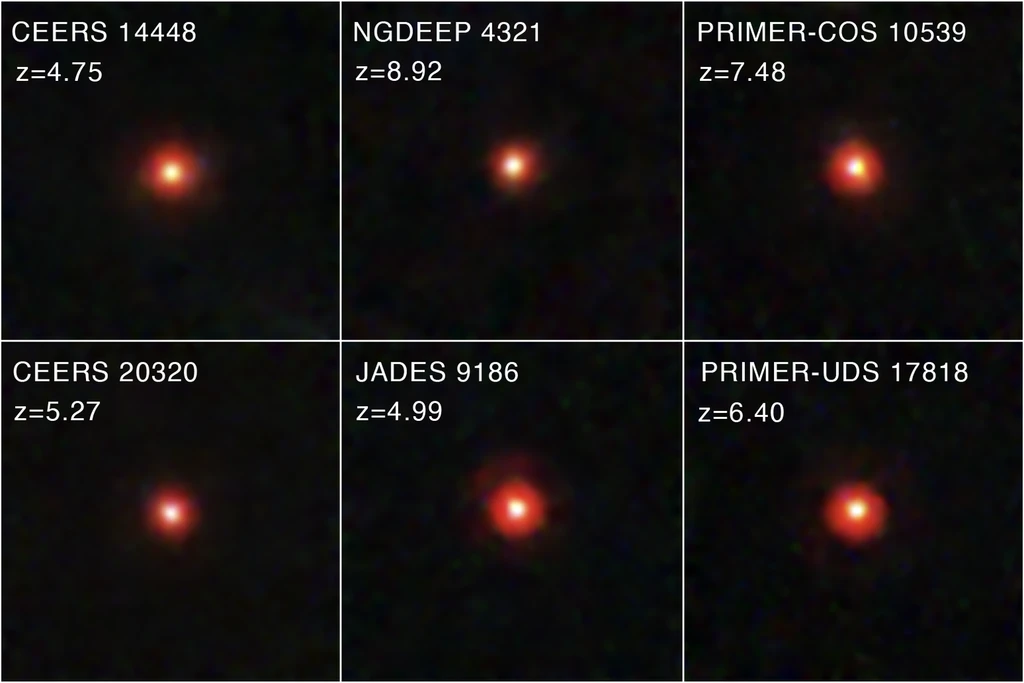
The finding bolsters the theory that LRDs are young black holes in a transitional phase, shrouded in dense gas. This rapid feeding period could explain how early supermassive black holes grew so massive so quickly.
Next-generation observatories like the Nancy Grace Roman Space Telescope will search for rare modern LRDs. The XRD itself warrants further study, as it could be either an aging LRD or a more common supermassive black hole cloaked in exotic dust.