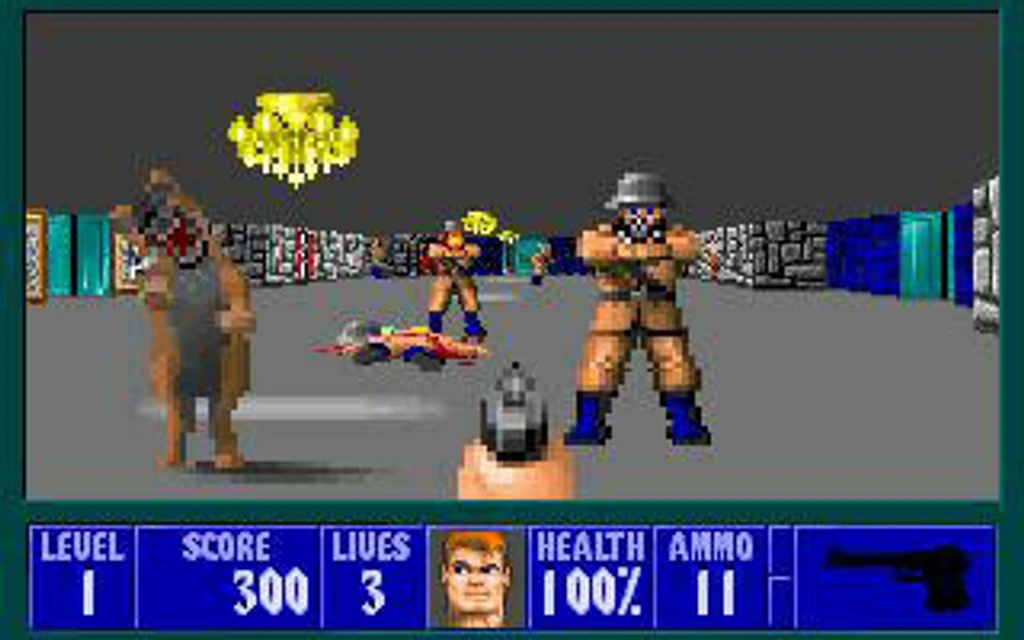
Achtung! Over three decades after its release, Wolfenstein 3D remains a landmark-but its rough edges are now unmistakable.
Not a lot of cover to be found in rooms like this... Credit: id Software
The game that launched the first-person shooter genre feels archaic by modern standards: rigid 90-degree hallways, no in-game map, and repetitive enemy encounters with minimal tactical depth. Yet it’s precisely these constraints that reveal how foundational Wolfenstein 3D was to everything that followed.
Being able to view a map, like this one pulled from the game’s files, would be really helpful while playing the game.
Combat lacks cover and nuance-success hinges on stunning enemies with rapid fire rather than positioning. Difficulty spikes erratically between laughably easy and punishingly hard. And while the game tracks score and lives like an arcade relic, the ability to save anywhere renders those mechanics obsolete.
If you lose a life, you can kiss that cool gun goodbye (unless you saved, that is). Credit: id Software
But here’s the surprise: Wolfenstein 3D is uniquely suited to one-handed mouse play. The mouse controls movement entirely-up/down for forward/backward, left/right for turning, with clicks handling firing, strafing, and doors. At high sensitivity, it enables whip-fast navigation that feels unexpectedly fluid.
No, that’s not Grok AI, it’s Mecha-Hitler! Credit: id Software
Despite its dated design, the game remains a brisk, nostalgic journey through the origins of a genre that now dominates global gaming.