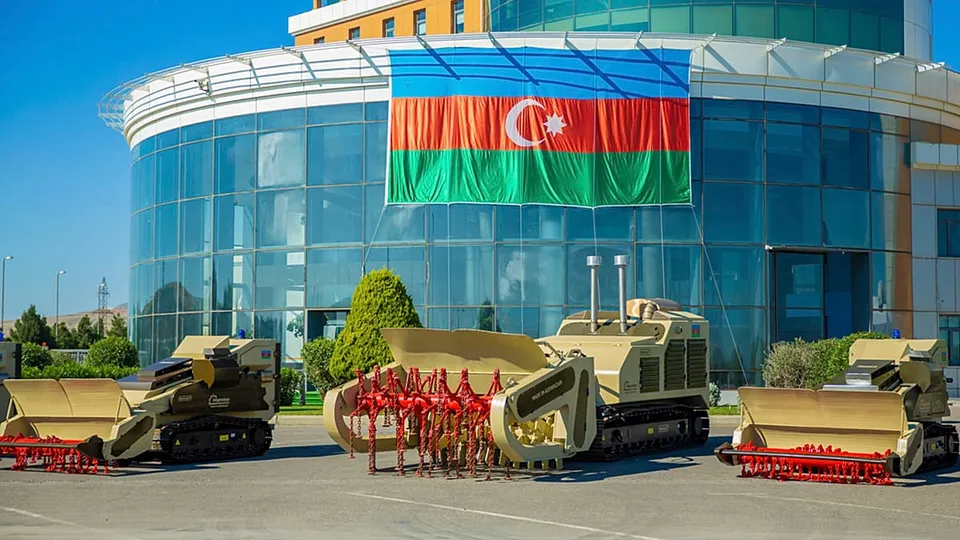
Azerbaijan is significantly expanding its use of homegrown remote-controlled demining machines to expedite humanitarian mine clearance in former conflict zones. These unmanned systems, developed by local firm ImProtex and operated by the Azerbaijan National Agency for Mine Action (ANAMA), are designed for high-risk environments where manual clearance is slow and perilous.
Vice President of ImProtex, Gunel Alakbarova, stated that landmines remain a critical humanitarian and security challenge, posing risks to life and hindering land use. Mechanized and remote-controlled platforms drastically reduce deminer risks while enabling operations across larger areas. The Revival T, a recent heavy mechanised model, is engineered to neutralize both anti-personnel and anti-tank mines in rugged terrain.
Emil Hasanov, deputy chairman of ANAMA’s Public Council, highlighted the efficiency gains: while individual deminers clear 20-50 square meters daily, mine detection dogs cover 200-400 square meters, and mechanical machines achieve 500-2,000 square meters per day. Alakbarova emphasized that automation is key to casualty reduction, with robotic systems minimizing human exposure to hazards.
This technological advancement supports reconstruction and the return of displaced communities, showcasing Azerbaijan's humanitarian mission and technological potential. The country has also presented its demining technology at international exhibitions.
Since the 2020 conflict, ANAMA reports over 240,000 hectares cleared and 227,000 mines neutralized, though contamination persists. The Azerbaijani government has allocated significant funds for mine action, and the EU is providing substantial assistance for clearance, risk awareness, and victim support.
Azerbaijan is extending its expertise internationally, including to Ukraine, where it has supplied unmanned demining vehicles and provided training. Globally, mines and explosive remnants of war remain a severe threat, causing thousands of casualties annually and impeding post-conflict recovery in numerous nations. Experts note the growing reliance on remote-controlled machines signifies a critical shift in humanitarian mine action, enhancing efficiency and reducing human exposure.