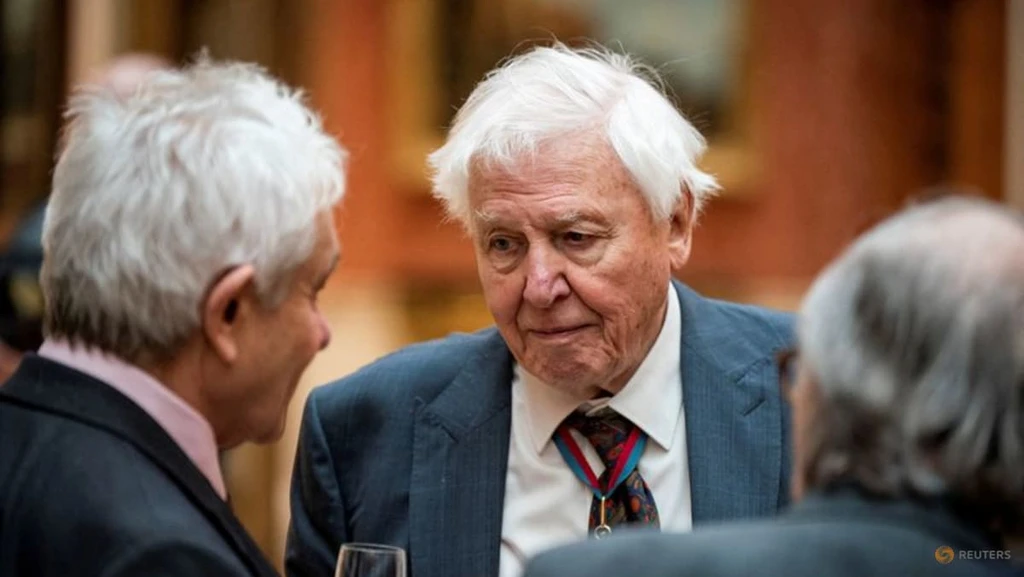
LONDON - Sir David Attenborough, the world's most authoritative voice on the natural world, turns 100 on Friday. After more than 70 years of filmmaking, his distinctive voice has become synonymous with nature's story. He remains at the forefront of environmental protection, producing some of his most impactful work in recent years.
Among his admirers are Britain's royal family, Barack Obama, and Billie Eilish. The late Queen Elizabeth praised his "unequalled ability to communicate the beauty and vulnerability of our natural environment.”
Attenborough's films have captured both wonder and tragedy. He made audiences marvel at orcas hunting seals and moved them to tears with the story of "Lonesome George," the last Pinta Island tortoise, whose death marked the extinction of his species.
With climate change accelerating, Attenborough devoted his 90s to raising awareness. His 2017 series "Blue Planet 2" highlighted plastic in the ocean, jolting public opinion. Images of albatrosses feeding plastic to their chicks prompted the British government and major retailers to reduce plastic use.
"I think every single person who's seen anything that Sir David has done has been inspired to care about nature," said Doug Gurr, director of the Natural History Museum in London.
In Britain, his centenary is marked with BBC specials, a concert at the Royal Albert Hall, nature walks, and tree planting. At 99, he remained heavily involved in program-making, driven by curiosity and joy.
Born May 8, 1926, Attenborough's BBC career took off in 1954 with "Zoo Quest." His 1979 series "Life on Earth" made him a household name. Decades later, his sense of urgency has only grown: "How could I look my grandchildren in the eye and say I knew what was happening to the world and did nothing?"