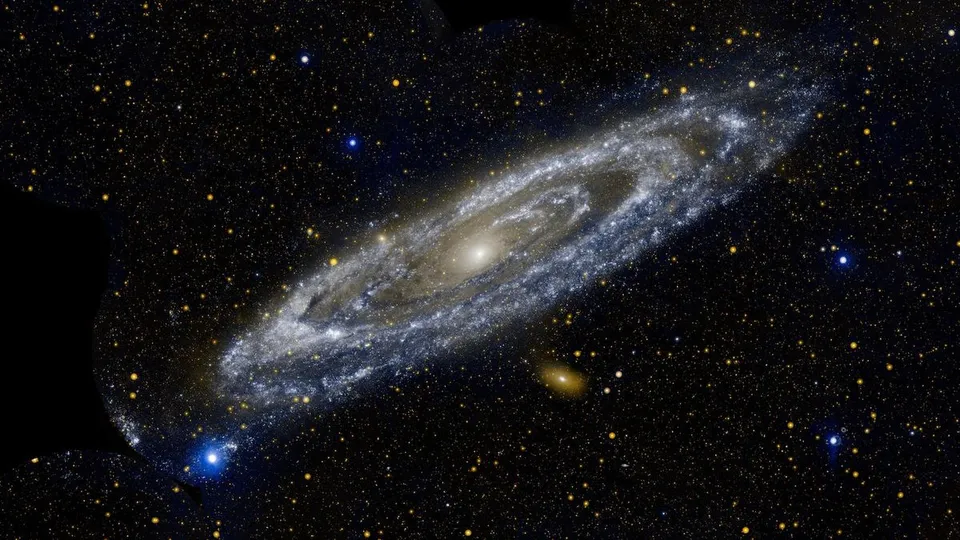
Scientists have potentially observed a massive star collapsing directly into a black hole, bypassing the expected supernova explosion. This phenomenon, predicted by theory but rarely seen, was identified in the Andromeda Galaxy.
The star, designated M31-2014-DS1, exhibited a significant increase in mid-infrared brightness over two years, followed by a dramatic fading. Researchers analyzed archival data spanning from 2009 to 2022, noticing the unusual dimming.
"This has probably been the most surprising discovery of my life," stated lead author Kishalay De, an astronomy professor at Columbia University. "The evidence of the disappearance of the star was lying in public archival data and nobody noticed for years until we picked it out."
Optical light curves showed the object faded by approximately 100 times between 2016 and 2019, becoming undetectable in ground-based observations by 2023. Hubble and Keck telescope data confirmed a faint near-infrared source.
This direct collapse scenario suggests that a supernova shock wave failed to eject the star's outer layers, causing the core to collapse into a black hole. The star, initially around 13 solar masses, lost most of its mass through stellar winds before its demise. This finding challenges the assumption that stars of this mass always explode. Another candidate, N6946-BH1, observed in a more distant galaxy, exhibits similar characteristics, though with less detailed data.
The discovery highlights the difficulty in detecting these quiet stellar deaths compared to the luminous signatures of supernovae. Future observations, potentially from the Vera C. Rubin Observatory, aim to uncover more such events and refine our understanding of stellar evolution.