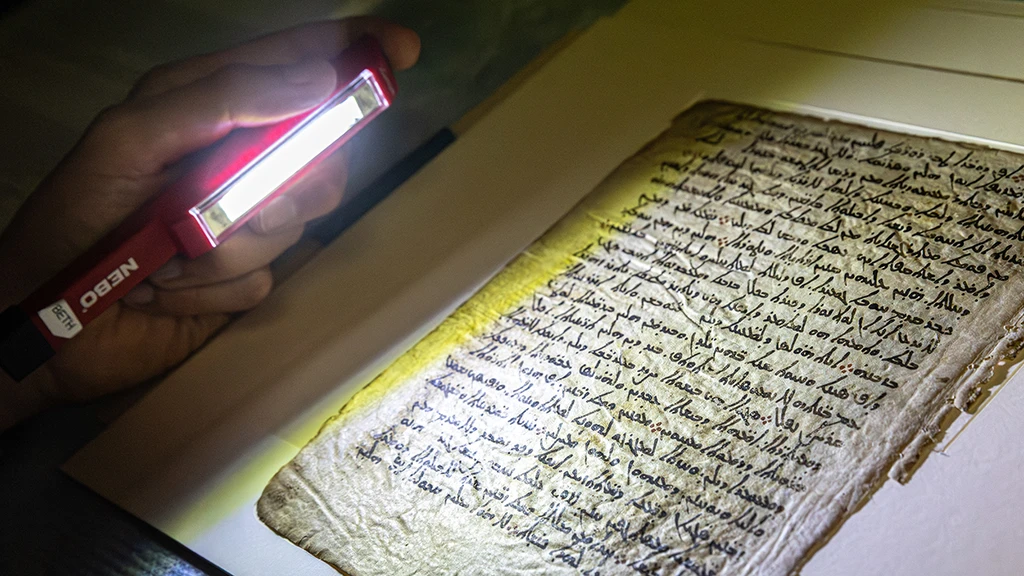
Researchers are reconstructing the oldest known map of the night sky, believed lost for centuries. Using X-rays on a medieval manuscript, scientists are revealing a hidden star catalog beneath existing text.
The map is attributed to the ancient astronomer Hipparchus, who lived around 190 to 120 BCE. He is credited as the first Western astronomer to create such a catalog and determine celestial motions, all without a telescope.
The manuscript, a palimpsest where parchment was scraped clean and reused, was identified in 2022. Researchers linked underlying astronomical references to Earth's precession, aligning with Hipparchus's era.

Currently, the Codex Climaci Rescriptus is undergoing scanning at the SLAC National Accelerator Laboratory. A synchrotron particle accelerator generates X-rays that differentiate between inks, revealing the faint, underlying text without damaging the fragile parchment. The monks used iron-rich ink, while the hidden Greek text has a calcium signature.
This process has already recovered star descriptions, including a reference to "Aquarius." The goal is to extract as many coordinates as possible to answer fundamental questions about the origins and rapid advancement of scientific inquiry.
The manuscript, likely originating from St. Catherine's Monastery in Egypt, was transported from Washington D.C. for this analysis. Despite challenges, including scattered pages worldwide, the reconstruction of this pioneering celestial map marks a significant breakthrough.