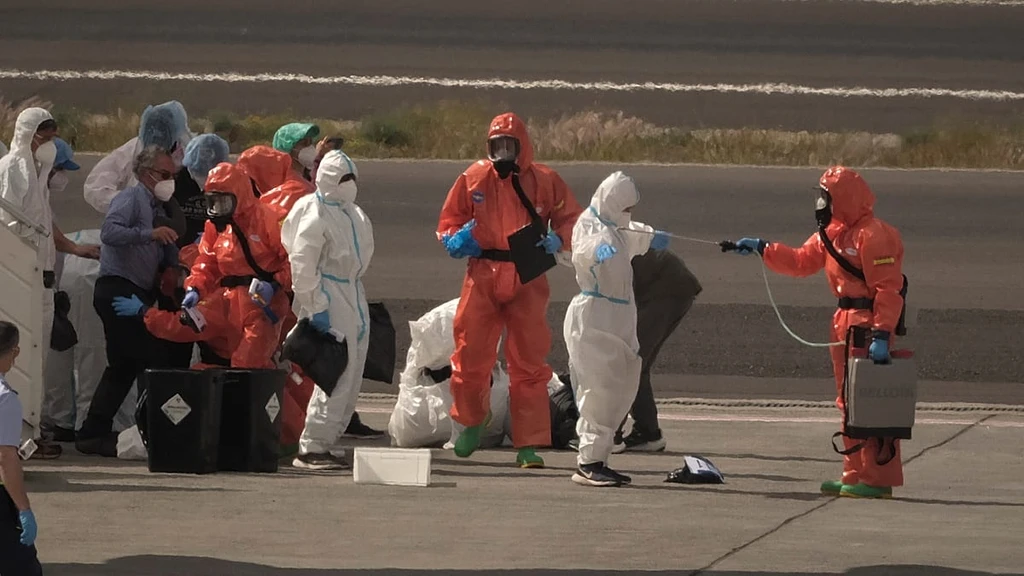
A new case of hantavirus has been confirmed in a woman evacuated from the MV Hondius cruise ship, French Health Minister Stéphanie Rist announced.
Two suspected cases identified by Spanish authorities have tested negative, the Spanish Ministry of Health confirmed.
The MV Hondius reached the port of Granadilla de Abona in Tenerife on Sunday. Passengers are being transferred to their home countries for medical tests and isolation.
The United States reported a passenger with mild symptoms and another testing mildly positive for Andes virus. Spain's Secretary of State for Health, Javier Padilla, clarified that Spanish and ECDC experts considered the PCR result indeterminate and treated it as negative, while the US considers it mildly positive.
In a separate but related case, a KLM flight attendant who worked a Johannesburg to Amsterdam flight on April 25 has tested negative for hantavirus. The attendant had fallen ill and was hospitalized in Amsterdam.
The World Health Organization has confirmed six cases linked to the outbreak and warned that more could emerge due to the virus's up to six-week incubation period.
WHO epidemiologist Maria Van Kerkhove emphasized, "This is not SARS-CoV-2. This is not the start of a COVID pandemic." She explained that hantavirus spreads through close, intimate contact, not like coronaviruses.
Three passengers have died, and nine others have fallen ill on the Dutch-flagged ship, which remains off the coast of Cape Verde with nearly 150 people onboard.
Countries across four continents are tracking passengers who disembarked before the outbreak was detected. Around 40 passengers left the ship after the first death, including the wife of a Dutch passenger who later died in South Africa.
Health authorities are investigating possible human-to-human transmission, considered rare. Officials believe the first infected person likely contracted the virus before boarding.
The ship left Argentina on April 1 on an Atlantic cruise, with stops including Antarctica and the Falkland Islands.