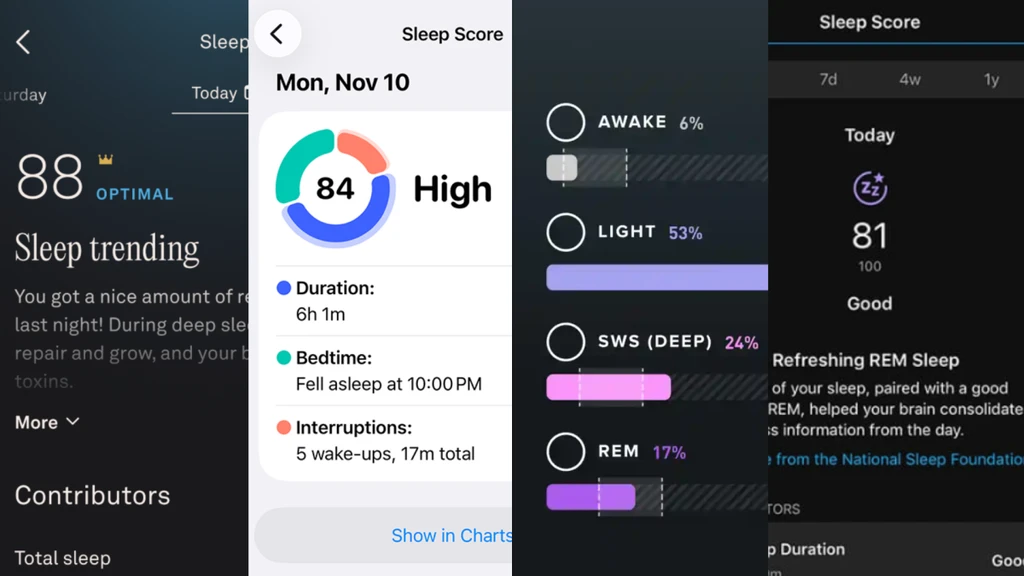
Sleep scores are a prominent feature in wearable health tracking, yet companies use disparate scales and signals to define them. A score of 75, for example, can be "Fair" on Garmin, "Good" on Oura, and "OK" on Apple Watch.
These scores are composite estimates, combining data like sleep duration, efficiency, and stages. However, no score is clinically "accurate." Wearables track estimated sleep time and stages, distilling them into a proprietary number that may reflect branding more than precise science. The true value lies in observing long-term trends rather than judging individual nights.
Oura, considered a top sleep tracker, scores sleep from 0-100, with 85-100 being "Optimal," 70-84 "Good," and below 70 "Pay Attention." It considers seven factors, including total sleep time, restfulness, and REM sleep. Oura's finger-based sensor is noted for accuracy.
Whoop offers two metrics: Sleep Performance (0-100%) and Recovery (0-100%). Sleep Performance measures how much of your needed sleep you achieved, based on sufficiency, consistency, efficiency, and stress. Recovery is a broader readiness score, color-coded Green (67-100%), Yellow (34-66%), and Red (0-33%). Whoop personalizes scores against your own baseline.
Garmin provides a 0-100 sleep score, with rankings from "Excellent" (90-100) to "Poor" (below 60). It blends sleep duration, quality, and autonomic nervous system activity derived from heart rate variability. Garmin also features a "Body Battery" to gauge energy reserves.
Apple Watch's sleep score, recently updated, is based on sleep duration (50 points), bedtime consistency (30 points), and interruptions (20 points). Its current scale ranges from "Very High" (96-100) to "Very Low" (0-40), focusing on sleep habits.
Fitbit, an early adopter of sleep scores, uses duration, quality, and restoration for a score up to 100. Most users score between 72-83. Restoration assesses how much your sleeping heart rate dips below your resting rate, though detailed analysis requires a Premium subscription.
A score of 75 signifies different things across platforms: "Good" on Oura, "Fair" on Garmin, "OK" on Apple Watch, and near the top of "Fair" on Fitbit. Whoop's percentage-based system is not directly comparable.
Ultimately, wearable sleep scores are not clinical measurements but estimates. They offer insights into personal sleep patterns and trends over time, serving as a guide for lifestyle adjustments rather than a definitive health assessment.