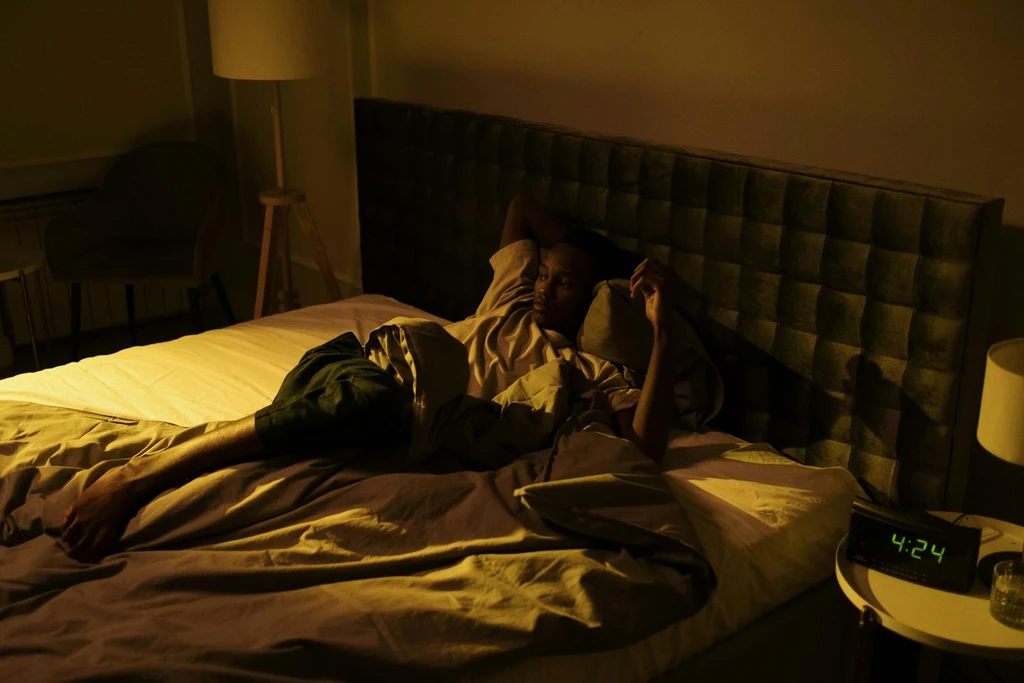
You know the ritual. Lights off, pillow adjusted, blanket pulled to the exact right height. And then your brain decides it’s time to replay old conversations or inventory every unresolved issue.

Research increasingly connects nighttime overthinking to early experiences of emotional unpredictability. A 2019 study found adults with anxious attachment styles reported higher rates of pre-sleep cognitive arousal. If your childhood environment was emotionally unstable, your brain learned: rest is risky.
Vigilance became the default. During the day, external stimuli occupy this system. At night, it turns inward, searching for threats in thoughts and memories.
This persistent overthinking often masquerades as productivity. Psychologists call it "cognitive hyperarousal," a strong predictor of chronic insomnia. It's not necessarily having more problems, but a different relationship with them - processing them through repetitive, unresolved thinking loops.

Polyvagal theory suggests our autonomic nervous system has states of safety or danger. Without consistent safety cues, the system remains mobilized, running a threat-detection program. The 2 a.m. thoughts often rationalize this bodily activation.
Simply telling an overthinking brain to relax backfires because it doesn't address the underlying appraisal of danger. Sleep hygiene recommendations fail when a baseline of felt safety is absent.
What helps is befriending the pattern, recognizing it as an adaptive response to past environments. Building a felt sense of safety through signals like deep pressure stimulation or slow exhales can recalibrate the nervous system. Creating a consistent "closing ritual" also signals to the brain that monitoring is over.
Ultimately, nighttime overthinking points to a trust problem. For brains that can't shut down, it suggests a deep-seated belief that rest is unsafe and vigilance is the only option. Understanding this is the first step toward recalibrating those settings through repeated experiences of safety.