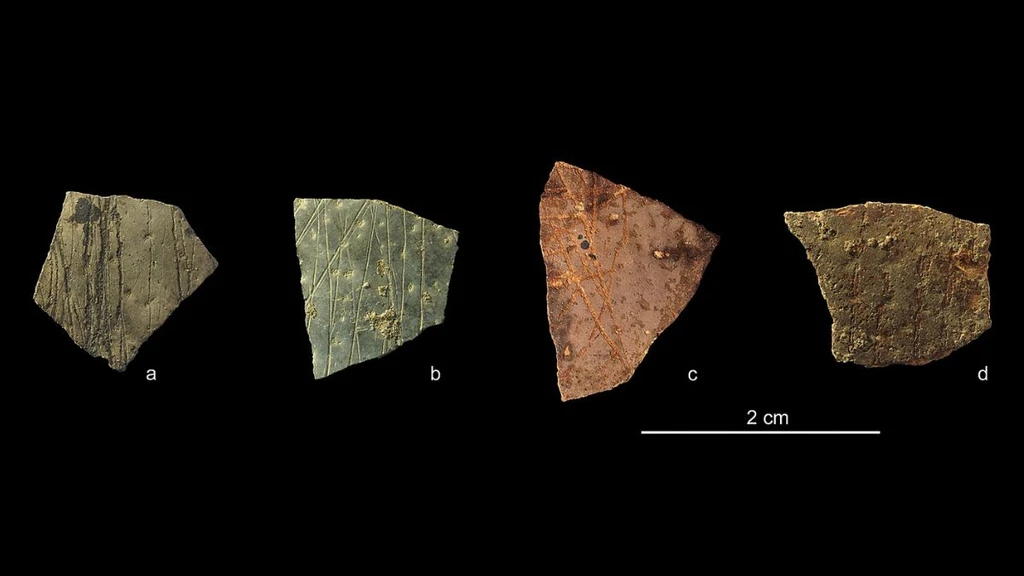
Ancient humans in southern Africa demonstrated remarkable geometric thinking 60,000 years ago, according to intricately engraved ostrich eggshells. These fragments, unearthed at sites in South Africa and Namibia, feature deliberate grids, diamonds, and repeated patterns-evidence of structured, intentional design.
Researchers analyzed 112 fragments with nearly 1,300 etched lines. Over 80% display consistent spatial regularity, including parallelism, right angles, and systematic repetition. The engravings suggest mastery of rotation, translation, and embedding-key cognitive operations underlying abstract thought.
The study, led by Silvia Ferrara and Valentina Decembrini at the University of Bologna, reveals that Homo sapiens at the time already possessed a visual grammar capable of transforming simple marks into complex systems-a foundation for art, symbolism, and eventually writing.