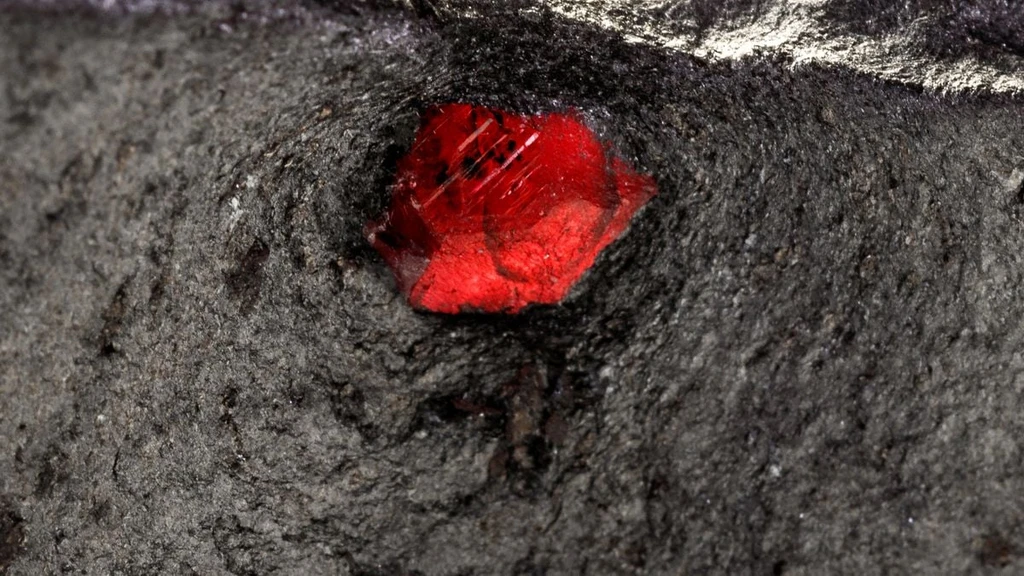
Researchers have identified garnet within a Mars meteorite for the first time, a discovery that fundamentally challenges current models of Martian geology. The mineral was found inside NWA 8171, a basaltic breccia currently housed at the Royal Ontario Museum. On Earth, garnet formation requires intense heat and pressure conditions never previously confirmed on Mars.
The specific mineral identified is andradite, an iron-rich garnet with an olive hue distinct from the gemstone variety. Researchers initially misidentified the grains as common pyroxene due to their small size and coloration. Follow-up chemical analysis confirmed the presence of this rare mineral in a fragment smaller than a poppy seed.
Garnets act as geological recorders, preserving data on temperature, pressure, and chemical environments. Their presence suggests Mars experienced significant metamorphism or unusual magma activity. Potential formation mechanisms include ancient meteorite impacts or magma rising into the crust. However, scientists must still verify if the garnet formed on Mars or arrived via external contamination before being incorporated into the breccia.
Upcoming isotope ratio analysis will determine the mineral's true origin. Confirmation of native Martian garnet would provide critical evidence of the planet's deep geological evolution and ancient environmental conditions. This finding opens a new window into understanding the thermal history of our planetary neighbor.