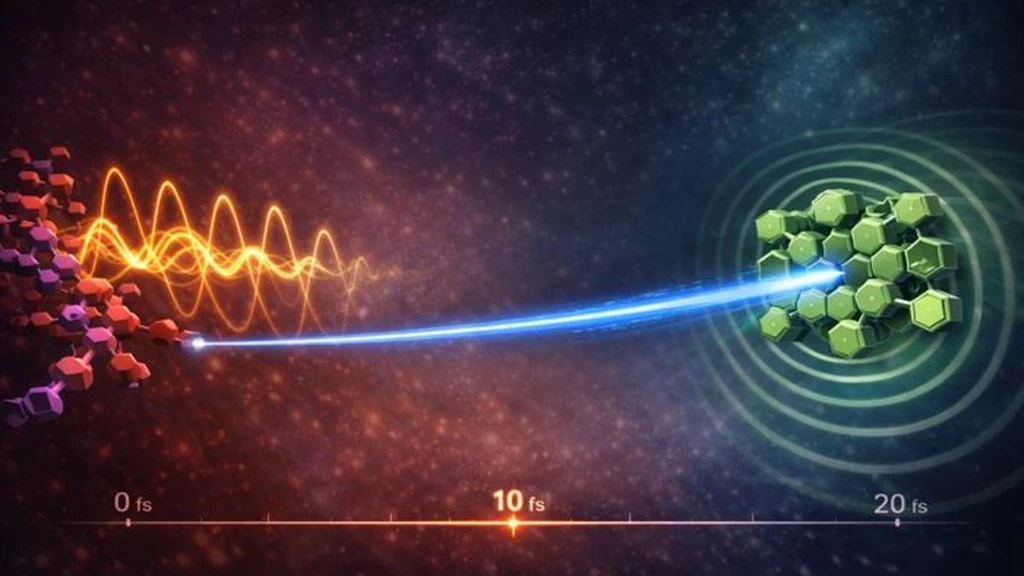
Physicists have observed electrons being “catapulted” across organic solar materials in just 18 femtoseconds-matching the speed of a single molecular vibration.
The discovery, led by researchers at the University of Cambridge, reveals that molecular vibrations actively drive charge transfer at donor-acceptor junctions, eliminating the need for strong electronic coupling or large energy offsets traditionally required in organic photovoltaics.
“Instead of drifting randomly, the electron is launched in one coherent burst,” said lead researcher Pratyush Ghosh. “The vibration acts like a molecular catapult.”
This mechanism could transform how scientists design next-generation solar cells-harnessing molecular motion as a tool rather than treating it as a limitation.