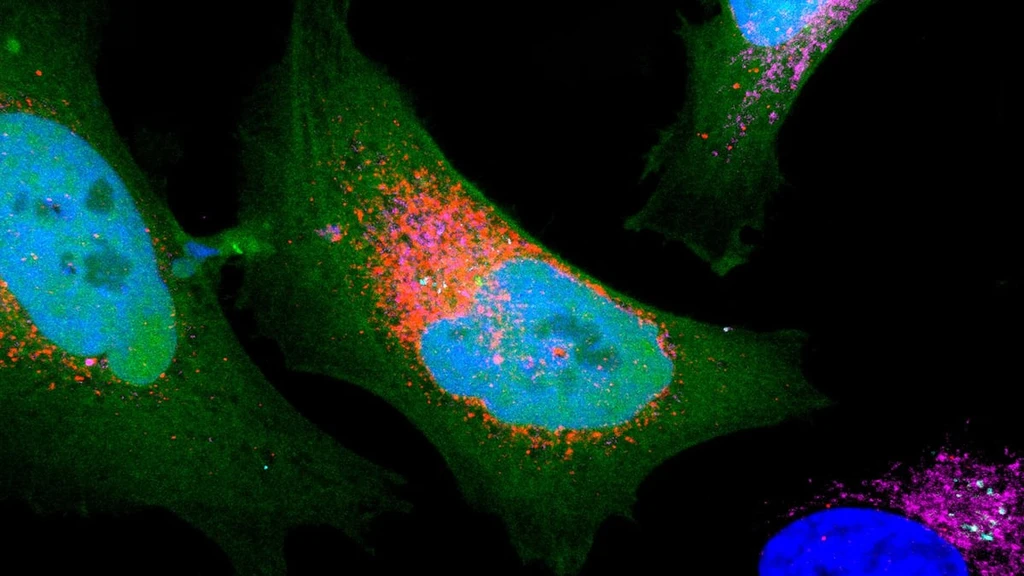
An international team of researchers has identified over 1,700 previously unknown 'dark' proteins, or microproteins, hidden within the human genome. These molecules, dubbed 'peptideins,' are produced from parts of DNA once dismissed as 'junk.'
Led by pediatric oncologist Sebastiaan van Heesch and geneticist Norbert Hübner, the team analyzed billions of data points from tens of thousands of experiments to find these tiny, unusual protein-like molecules.
The newly discovered microproteins (left) differ from standard proteins (right) in several ways, including their size. (Deutsch et al., Nature, 2026)
Unlike standard proteins, many peptideins are much smaller. The researchers found that one specific peptidein, produced from a gene called OLMALINC, appears to play a role in cancer survival. When deactivated in lab tests, cancer cells struggled to grow.
A cancer cell expressing a 'dark' microprotein (in red). (© Ting Luo/Princess Máxima Center for Pediatric Oncology)
This discovery suggests the 'dark genome' is far more active than previously thought, producing functional molecules that could open new doors for treating diseases like cancer and cardiovascular disorders.
The findings were published in Nature.